
U.S. Triple Crown: Races, History and Handicapping
On this page 22 sections
- The Three Races
- How the Series Developed
- All 13 Triple Crown Winners
- Qualification and Eligibility
- The Kentucky Derby Task
- The Preakness Task
- The Belmont Task
- Why the Handicap Must Be Rebuilt
- Review Replays, Not Just Finishes
- Recovery and Fresh Entrants
- Test the Fresh-Horse Theory
- Distance and Pedigree
- Price the Horse Before the Story
- Implied Probability Reference
- Choose the Pool That Matches the Opinion
- A Three-Race Notebook
- Worked Series Exercise
- Bankroll Boundaries
- Current Sources for Each Leg
- Triple Crown Checklist
- Keep the Series Record Distinct
- A champion’s complete career
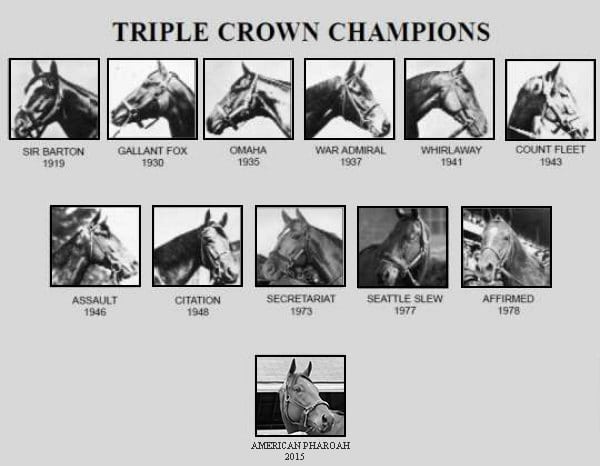
The U.S. Triple Crown links the Kentucky Derby, Preakness Stakes, and Belmont Stakes, but each leg presents a different field, recovery schedule, distance, venue, and pace problem. Thirteen horses have won all three races. A current guide should distinguish that stable history from the conditions of a particular year.
The Three Races
The Kentucky Derby is traditionally run at Churchill Downs on the first Saturday in May over 1¼ miles. The Preakness normally follows two weeks later and uses a distance of 1 3/16 miles. The Belmont traditionally concludes the series in New York.
Temporary construction can change the last two venues or distances. In 2026, the Preakness was held at Laurel Park while Pimlico was redeveloped. The Belmont was held at Saratoga over 1¼ miles rather than its traditional 1½ miles. Verify the official schedule, conditions, and venue for the named year.
| Leg | Venue | Distance |
|---|---|---|
| Kentucky Derby | Churchill Downs | 1¼ miles |
| Preakness | Laurel Park during redevelopment | 1 3/16 miles |
| Belmont Stakes | Saratoga during reconstruction | 1¼ miles; traditional Belmont Park race is 1½ |
How the Series Developed
The three races existed before they were organized as one recognized championship. Sir Barton swept them in 1919 and was later recognized as the first Triple Crown winner. The expression gained broader use during the 1930s, and the races settled into their familiar Derby–Preakness–Belmont order.
The short schedule became part of the challenge: three major races, ordinarily at three tracks, with limited recovery between starts. That does not make every campaign identical. Field size, travel, weather, surface, and the number of prior starts vary by year and horse.
All 13 Triple Crown Winners
- 1919 — Sir Barton
- 1930 — Gallant Fox
- 1935 — Omaha
- 1937 — War Admiral
- 1941 — Whirlaway
- 1943 — Count Fleet
- 1946 — Assault
- 1948 — Citation
- 1973 — Secretariat
- 1977 — Seattle Slew
- 1978 — Affirmed
- 2015 — American Pharoah
- 2018 — Justify
American Pharoah ended the 37-year interval after Affirmed. Justify became the 13th winner three years later. The list counts horses that completed all three races, not the larger number of horses with one or two classic wins.
Qualification and Eligibility
The races are restricted to eligible three-year-olds under their current conditions. Kentucky Derby participation uses a published points and eligibility system, while the Preakness and Belmont have their own nomination, supplemental, field-selection, and entry rules.
A Derby field can contain up to 20 starters, but scratches can reduce it. Do not treat 20 as guaranteed or assume the other legs will have the same horses. Open the official entries and conditions for each race.
The Kentucky Derby Task
The Derby brings together three-year-olds through a points and eligibility system and places them in the largest field most will have faced. The run to the first turn, crowd, kickback, traffic, and unfamiliar 1¼-mile distance can expose a horse that previously received clean trips.
Post position matters through the surrounding horses and running style. An inside runner can save ground or become trapped; an outside runner can avoid traffic or travel wide. Build the pace after the draw rather than applying a permanent good-post list.
The Preakness Task
The Preakness arrives quickly and usually replaces some Derby starters with new entrants. Its 1 3/16-mile distance is shorter than the Derby, but the likely pace matters more than the simple distance reduction. A Derby closer may receive less early help, while a pace horse may encounter fewer challengers.
Review the Derby trip and current preparation without diagnosing every returning horse as tired. Fresh entrants must still demonstrate sufficient class, speed, and fit with the new race.
The Belmont Task
The traditional Belmont Park race tests 1½ miles, efficient energy use, and position around a broad course. Temporary Saratoga editions at 1¼ miles created a different race. State the venue and distance before using historical patterns.
The last leg can include a Triple Crown candidate, Derby or Preakness runners, and horses arriving through other routes. Rebuild the field and resist letting the championship narrative determine the probability.
Why the Handicap Must Be Rebuilt
The Derby’s large field can create traffic and early competition for position. The Preakness often has a smaller and different field, while the Belmont may add runners who skipped one or both earlier races. A horse can receive a favorable Derby trip and face a very different Preakness setup.
Start each leg from a blank pace map. List leaders, pressers, stalkers, and closers after scratches. Write a primary scenario and an alternate, then evaluate which runners benefit in both and which require one narrow trip.
Review Replays, Not Just Finishes
Record ground loss, traffic, pace pressure, position at key calls, and whether the surface or race shape favored a particular style. A fourth-place horse may have run better than the placing suggests, while a winner may have conserved energy through an ideal trip.
Replay notes should inform the next projection without becoming excuses for every loss. Compare them with figures, class, distance, surface, and current preparation.
Recovery and Fresh Entrants
A Derby or Preakness starter has recent evidence against strong competition but may have endured a demanding trip. A runner that skipped an earlier leg has more calendar recovery but can lack comparable class or race fitness. Neither group deserves an automatic advantage.
Public works, veterinary decisions, travel, and attributed trainer comments add context. They cannot measure recovery perfectly. Avoid diagnosing fatigue from a finish alone or declaring every fresh horse fully prepared.
Test the Fresh-Horse Theory
Claims that fresh Preakness or Belmont entrants are systematically underbet require a complete dataset. Define “fresh,” select the period before viewing results, include every starter, and record final odds, stakes, finish, and payout. Compare equal-unit return and implied probability.
Separate the temporary Saratoga Belmonts from 1½-mile Belmont Park editions. Test the rule on later races. Without those steps, the claim remains a story built from memorable winners rather than a validated wagering method.
Distance and Pedigree
Many Derby runners are trying 1¼ miles for the first time. At the traditional Belmont distance, many face 1½ miles for the first time. “All” remains too strong because international or unusual prior form can differ.
Use pedigree with prior route form, finishing energy, pace, and efficiency. A stamina-oriented family does not guarantee that a horse will settle, avoid traffic, or distribute energy effectively.
Price the Horse Before the Story
Triple Crown attention can produce large pools and late odds movement. It does not guarantee generous prices, huge payoffs, or uninformed opposition. A famous contender can be underpriced, fairly priced, or overpriced depending on the live pool and a reasonable probability estimate.
Suppose a horse appears to win 24% to 29% of plausible scenarios. Exact 3-1 odds imply a 25% simple break-even rate. The low end offers no margin; the high end offers a modest one. At 2-1, the implied rate is 33.3%, above the whole estimate, so the horse becomes a pass despite remaining a leading contender.
Implied Probability Reference
- Even money: 50% simple break-even rate
- 2-1: 33.3%
- 3-1: 25%
- 4-1: 20%
- 5-1: 16.7%
- 9-1: 10%
These are simple fractions before any uncertainty in the estimate. Pari-mutuel prices can move until the pool closes, and displayed probable payouts for exotics require their own pool data.
Choose the Pool That Matches the Opinion
A win bet expresses the view that one horse is offered above a fair price. An exacta expresses an opinion about the top two and their order. Trifectas, superfectas, and multi-race bets require more outcomes and can grow rapidly when selections are added.
A 50-cent Pick 3 using three horses, two horses, and four horses contains 3 × 2 × 4 = 24 combinations and costs $12. Adding one horse to the middle leg raises it to 36 combinations and $18. Calculate the whole ticket before betting and use only discretionary money.
A Three-Race Notebook
Before the Derby, save the field, fair-price ranges, pace map, and ticket. Afterward, grade the process and create trip notes. Repeat from a blank page for the Preakness, then again for the Belmont.
Do not rewrite the original reasoning after seeing the result. Mark whether a mistake came from probability, pace, class, distance, trip interpretation, or price discipline. Ordinary variance is also possible when the analysis was reasonable.
Worked Series Exercise
Before the Derby, choose three contenders and write a low and high win estimate for each. Record the expected pace, minimum price, and one condition that would make each horse a pass. Save the final tote price and trip notes after the race.
For the Preakness, begin again with the confirmed field. Carry forward only evidence from the Derby replay: ground loss, pace pressure, traffic, and finishing energy. Add new entrants on the same figure scale. Do not give the Derby winner an automatic probability bonus or penalty.
Repeat for the Belmont using its actual venue and distance. At the end, compare the three pre-race worksheets with the outcomes. The goal is to improve estimates and decisions, not to prove that one narrative always wins.
Bankroll Boundaries
Set one discretionary Triple Crown budget before the first race and divide it by day or confidence. Losing the Derby does not increase the probability of a Preakness opinion, and a winning Preakness does not make Belmont profit risk-free.
Never use money needed for housing, food, debt, health, transportation, or other essentials. The option to pass all three races remains part of a sound plan.
Current Sources for Each Leg
Use Churchill Downs for the Derby field and conditions, the official Preakness site for the current Maryland venue, and NYRA for the Belmont venue and distance. Archived previews remain useful history only when their year is visible.
Triple Crown Checklist
- Confirm the current venue, distance, conditions, and field.
- Update scratches, weather, surface, and equipment.
- Review prior-race trips and recovery evidence.
- Rebuild primary and alternate pace maps.
- Estimate a probability range before viewing the tote.
- Set a minimum price and count every ticket combination.
- Record the decision for review after the race.
Continue with the current guides to the Kentucky Derby, Preakness Stakes, and Belmont Stakes.
Keep the Series Record Distinct
Winning two legs is a major achievement but is not a Triple Crown. When reading a trainer or rider profile, distinguish the number of individual classic victories from the number of complete sweeps. A career total can include different horses and different years, while the sweep requires the same horse to win all three in one season.
A champion’s complete career
For a horse-specific account alongside the general Triple Crown history, read Assault’s career profile. Following the full record helps separate a famous three-race achievement from what happened before and after it, and keeps the results tied to their historical conditions.
Related research
Continue the Analysis
Horse Betting for Beginners
Start with the race, the ticket, pools, odds, and a sensible first-bet workflow.
ContinueUnderstand Bet Types
Compare straight, exotic, and multi-race wagers before building a ticket.
ContinueLearn to Handicap
Build a repeatable process around form, pace, class, distance, surface, and price.
Continue