
Horse Racing Reference
On this page 6 sections
The draft horse breeds are not ones found in horse racing. Still, fans of horse racing might want to learn more about these amazing horses. From the noble and gentle Friesian to the majestic Clydesdale and Brabant, draft horses are a specimen to behold. Here is some information on these breeds.
| Breed or type | Useful distinction |
|---|---|
| Clydesdale | Scottish draft breed associated with pulling and ceremonial hitches. |
| Belgian / Brabant | Heavy draft types with related origins; American and European breeding developed differently. |
| Friesian | Dutch riding and driving breed, distinct from a Brabant despite a substantial build. |
| Thoroughbred | A separate breed associated with flat racing, rather than a draft classification. |
The Friesian Horse Association of North America’s introduction describes the breed’s Dutch origin and dressage, driven dressage and show-driving disciplines. A horse’s size, feathering or temperament should not substitute for its registry and breeding history when identifying it.
The Clydesdale Horse
 The beautiful Clydesdale is believed to have originated in Scotland. Though its origins are celebrated by the Scottish people, this breed is now more known for its role as a brand ambassador for Anheuser-Busch. The famous Budweiser Clydesdales make hundreds of appearances each year. They are even the subject of a yearly Super Bowl commercial.
Clydesdales are known for their large size. They are also, like most draft breeds, used for pulling. A team of 8 horses are used to pull the Budweiser wagon. In their history the Clydesdales were also prized for the ability to move large loads.
As a side note, if the Budweiser Clydesdales come to your town you should not miss the occasion! The team arrives in state of the art trailers, and each of the horses has its own special groom decked out in an official uniform. The horses are usually stabled in a nice facility with each horse having its own stall.
A Clydesdale horse generally weighs between 700-1000 kg and stands between 167-183 cm. Even though the horses are very large they are generally considered to be very docile. The Clydesdale is a horse breed, not a separate species. Conservation assessments concern its breeding population and can change over time; a prominent promotional team does not establish the population status of the breed as a whole.
The Brabant Horse
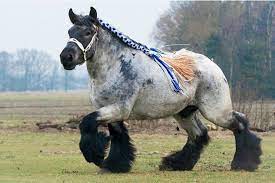 The Belgian horse is sometimes referred to as the Brabant horse. It originated in Belgium and is among the strongest of the draft breeds. This hearty animal was bred for the harshest of conditions. Brabant horses have an average weight of 900 kg for males and 700 kg for females. They stand about 168 cm tall.
It is believed by some that the destriers of the Middle Ages were the ancestors of the modern Belgian horse. There is no specific evidence to support this claim. It is interesting to note that in the years following World War II, breeding was engineered for the Brabant horse to make the animal taller and leaner in the United States. In Europe, the horse was bred to be heavy and stout. This was presumably because draft horses were more heavily used in a practical way at that time in Europe.
An organization was ultimately founded in Indiana to maintain registry records for Belgian Draft Horses in the United States. The American Association of Importers and Breeders of Belgian Draft Horses may also be given some credit for making the Brabant horse the most popular type of draft horse seen in America today.
The Friesian Horse
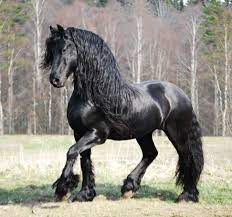 The Friesian is included here as a related riding and driving breed, rather than as another name for a Brabant. Its Dutch origin, breeding history and modern sporting roles distinguish it from the heavy Belgian draft breeds. Friesian horses are known for their curly manes and tails. Most Friesians are black in color. They stand an average of 15-17 hands high, though height alone does not place a horse in the heavy draft category. The shortest of the breed are not much taller than the average horse.
The Friesian is associated with a black coat, long mane and tail, and feathering around the lower legs. Coat appearance alone does not establish a horse’s registered breed. Friesians also compete as riding and driving horses, including in show disciplines. They compete in various riding competitions and can be a sight to behold when trained well. Their unique style of movement and gait is a pleasure to watch in the arena.
Just like the Brabant horse, there are two different types of Friesian conformations to be found in modern examples of the breed. The sport variety of the horse is generally thinner with finer bones. This is the variety of the horse that is usually found in the show ring.
Draft Horses in Modern Agriculture and Sport
While draft horses are no longer the agricultural workhorses they once were before mechanisation transformed farming in the twentieth century, they remain a vital and celebrated part of equine culture worldwide. In North America, breeds like the Clydesdale, Percheron, and Belgian are still used for logging in environmentally sensitive areas where machinery would cause excessive ground disturbance, for small-scale sustainable farming operations, and increasingly for therapeutic and educational programmes that benefit from working with large, gentle animals.
Draft horse competitions, including pulling contests and hitch classes at agricultural shows, draw enthusiastic crowds across North America and Europe. These events celebrate the power and training of these remarkable animals in ways that connect modern audiences with the agricultural traditions of earlier generations. The Budweiser Clydesdales are perhaps the most famous draft horses in popular culture, having appeared in Super Bowl advertisements and promotional tours for decades as symbols of strength, beauty, and American heritage.
The Difference Between Draft Horses and Thoroughbreds
Understanding the physical and temperamental differences between draft breeds and the thoroughbreds that dominate racing helps put both in context. Where thoroughbreds are bred for speed, agility, and competitive fire — a combination that makes them exciting to watch but sometimes challenging to handle — draft breeds are selected for calm temperament, steady work ethic, and the physical strength to exert sustained pulling force. A Clydesdale can weigh twice as much as a thoroughbred and possesses a fundamentally different body structure optimised for power rather than speed. For horse racing fans curious about the full diversity of equine breeds and disciplines, our article on age of horses in horse racing provides useful context on how thoroughbreds develop compared to other breeds.
Draft Horses and Horse Racing
You may be wondering if these draft horses compete in the sport of horse racing. They are not the breeds entered in conventional Thoroughbred racing. Local exhibitions or novelty events should be distinguished from the regulated race program. The most familiar type of flat horse racing is contested among thoroughbreds in the United States and abroad.
Draft horses do not have the body style that would be appropriate for horse racing. That is a way of saying that they are too heavy. These horses cannot carry the speed that is required to be competitive in horse racing. What they can do very well is pull heavy loads.
In certain places of the United States, specifically the Amish populations of Pennsylvania and Kentucky, the draft breeds are used in the important work of farming. They are used almost exclusively in the place of modern equipment.
It is a wonderful thing to learn more about the breeds of horses throughout the world. Even though they do not compete in racing events, the draft horse breeds are amazing to watch and enjoy. You may even see the famous Budweiser Clydesdales when you attend live horse racing in your area. Many horse racing tracks welcome these horses to the track for special events.
If interested in horse betting, check the horse betting sites we recommend. Read the Bovada racebook review, Amwager review, BUSR review, Mybookie review and others. Compare their actual eligibility, racing coverage and account terms before choosing. online racebook comparison for readers comparing available options.
Related:
Related research
Continue the Analysis
Horse Betting for Beginners
Start with the race, the ticket, pools, odds, and a sensible first-bet workflow.
ContinueUnderstand Bet Types
Compare straight, exotic, and multi-race wagers before building a ticket.
ContinueLearn to Handicap
Build a repeatable process around form, pace, class, distance, surface, and price.
Continue