
Santa Anita Park Racetrack
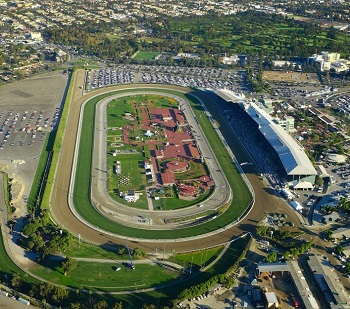
Santa Anita Park in Arcadia, California, opened in 1934 beneath the San Gabriel Mountains. The active racetrack conducts racing on a dirt main track, a turf oval, and its distinctive downhill turf course. Its calendar, stakes conditions, and course use change by meet, so current official information should control race-day and visitor decisions.
2026 racing calendar
Santa Anita’s winter and spring racing includes the Santa Anita Handicap and Santa Anita Derby. Live racing then returns after the Del Mar summer season. The track announced a 19-day 2026 Autumn Meet from September 25 through November 1, with 26 stakes and seven Breeders’ Cup Challenge events: official Autumn Meet announcement.
A meet date is not a promise that every calendar day contains live racing. Check the official event calendar for the specific date, then confirm first post, tickets, parking, dining, accessibility, and any special-event restrictions.
The Santa Anita Handicap
The Santa Anita Handicap, widely known as the Big Cap, is closely connected with Seabiscuit. He was defeated in 1937 and 1938 before winning the 1940 edition in the final start of his career. Other notable winners include Ack Ack, Affirmed, Spectacular Bid, John Henry, Lava Man, and three-time winner Game On Dude.
Purses and conditions change. On March 7, 2026, the Big Cap was a Grade 1 for horses four and older at 1¼ miles on dirt with a $300,000 purse. Those details describe that edition and should not be copied into later years without checking the new condition book.
The Santa Anita Derby
The Santa Anita Derby is an important spring race for 3-year-olds progressing toward the Kentucky Derby. Its winners have included horses who later succeeded in Triple Crown races, but winning a prep does not guarantee success at Churchill Downs. Field size, pace, surface, distance, travel, and the individual horse’s development can all change.
I’ll Have Another won the Santa Anita Derby, Kentucky Derby, and Preakness in 2012. Injury forced his withdrawal before the Belmont. That sequence should be described as two classic wins and an ended Triple Crown attempt, not a completed three-race comparison.
Three course contexts
Santa Anita’s main track is dirt. Turf races can use the conventional oval or the downhill course, which begins above the main oval and includes a crossing of the dirt track. The program’s exact course designation matters.
| Course | Research question |
|---|---|
| Main dirt | How do pace, kickback and run to the turn fit the field? |
| Turf oval | What are the rail setting and relevant route conditions? |
| Downhill turf | Is there experience with this layout and crossing? |
A win on one Santa Anita surface does not prove ability on the others. Split venue statistics by exact surface and course before using them.
Testing an apparent bias
One wire-to-wire winner after an uncontested lead does not establish a speed-favoring track. Collect several comparable races and record field size, distance, surface, condition, first-call position, pace pressure, winner’s odds, and rail setting for turf. Separate a pace advantage from evidence about the surface itself.
If the sample mixes downhill sprints, turf routes, and dirt races, it is too broad. Publish the date range and every included race before calling a pattern useful. Then calculate equal-stake returns to see whether the public already priced it.
Evaluating an overseas runner
International horses may bring form from different course shapes, going descriptions, timing methods, medication rules, and class structures. Convert distances, identify whether figures are already adjusted, and avoid applying the same conversion twice. Origin alone establishes neither superiority nor disadvantage.
Separate visitor facts from racing analysis
Admission, parking, dining hours, dress expectations, and first post are operational facts that can change from one event to the next. Surface, distance, pace, and odds are handicapping inputs. Keeping those sections separate lets a reader verify a visit without mistaking an old event schedule for racing analysis.
The same rule improves links. Official entries and scratches should lead to the track or its recognized data provider; ticketing and accessibility should lead to official visitor pages. Historical profiles can explain why a race matters, but should not route a current planning decision through an unrelated wagering promotion.
Race-day checklist
- Open the official entries and identify dirt, turf oval, or downhill turf.
- Confirm distance, conditions, field size, rail position, and scratches.
- Check weather and whether any turf race has moved to dirt.
- Sketch the expected pace and note horses facing a new course.
- Assign fair probabilities before checking final odds.
- Total every combination and keep the stake within the planned limit.
Historical coverage of California racing policy and safety belongs in clearly dated archives. For current operations, use Santa Anita’s own calendar, racing office material, entries, and changes. Continue with the racetrack guides, the handicapping library, and the ticket calculator.
Recording a downhill trip
In a replay note, distinguish trouble at the break, position through the turn, the dirt crossing and the final run on turf. “Turf sprint” alone can hide the particular problem a horse faced. Compare that note with the next race’s exact course designation before assuming the horse will face the same configuration again.
A runner switching from the downhill course to an oval sprint may encounter a different rhythm and positioning problem even if the listed distance is similar. Treat course experience as one input alongside current condition, class, pace and price.
Related research
Continue the Analysis
Major Racing Events
Explore Triple Crown races, championships, festivals, and international meetings.
ContinueRacetrack Guides
Learn how layout, surface, configuration, and conditions shape a race.
ContinueHandicapping Library
Study form, pace, class, figures, distance, surface, and price.
Continue