
Russell Baze: Career Record and Jockey Profile
Russell Baze retired in June 2016 with 12,842 victories, more than any jockey in North American racing history. His 42-year career was built largely at Golden Gate Fields and Bay Meadows, where exceptional durability, local knowledge, and access to competitive mounts produced sustained success. The completed record replaces old references to active mounts and future retirement.
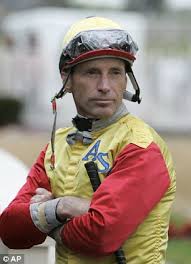
Completed career record
The National Museum of Racing and Hall of Fame records 12,842 wins, earnings of $199,334,219, and a 23.96% career win rate. Baze rode professionally from 1974 through 2016.
| Measure | Completed total | Context |
|---|---|---|
| Career wins | 12,842 | North American record |
| Career earnings | $199,334,219 | Mount earnings |
| Career win rate | 23.96% | Wins divided by starts |
| Golden Gate wins | 5,765 | With 54 riding titles |
| Bay Meadows titles | 40 | Every meet from 1981 through closure in 2008 |
From Washington to Northern California
Baze was born in Vancouver, British Columbia, in 1958 and came from a racing family. He began riding professionally at 16 and won his first race at Yakima Meadows on October 28, 1974 aboard a horse trained by his father.
Northern California became the center of his career. Concentrating on one circuit reduced the national visibility that comes with Triple Crown and Breeders’ Cup mounts, but it also demanded repeated performance against riders and trainers who knew his habits. His totals reflect skill, opportunity, longevity, and an unusually high workload.
Golden Gate and Bay Meadows
Baze won 5,765 races and 54 riding titles at Golden Gate Fields. At Bay Meadows he won 40 titles, including every meet from 1981 until the track closed in 2008. Those figures document dominance across multiple decades and surface changes.
Local familiarity can help with judging turns, short stretch runs, wind, kickback, and the tendencies of regular rivals. It can also be overbet. The more visible a rider’s advantage becomes, the more likely the public is to reduce the price.
Bay Meadows’ closure and Golden Gate’s later closure also mean that a current article cannot direct readers to watch Baze at those venues. The career and tracks now belong in historical analysis.
Passing Laffit Pincay Jr.
On December 1, 2006, Baze won aboard Butterfly Belle at Bay Meadows for career victory 9,531. That moved him past Laffit Pincay Jr. for the North American jockey wins record. Willie Shoemaker had held an earlier record, but Pincay was the rider Baze passed.
Baze became the first North American rider to reach 10,000 victories in February 2008. He continued for eight more seasons, finishing with 12,842. The sequence should be stated with dates rather than mixing several generations of the record.
Volume and yearly leadership
Baze led North American jockeys in wins 13 times: 1992–1996, 2000, 2002, 2005, 2007–2009, 2012, and 2014. He recorded at least 400 victories in 13 different years, including a career-high 448 in 1995.
He received a Special Eclipse Award in 1994 after exceeding 400 wins in four consecutive years. The award year is 1994, even though the highest single-season total came in 1995.
Hall of Fame and leading horses
Baze entered the Hall of Fame in 1999 and received the George Woolf Memorial Jockey Award in 2002. His Grade 1 victories included the Ancient Title, King’s Bishop, Santa Monica Handicap, and Oak Tree Invitational Handicap.
Notable mounts included Lost in the Fog, Shared Belief, Hawkster, Smiling Tiger, Lite Light, Lexicon, and Bold Chieftain. Those horses add quality context to a career often summarized only by its enormous win count.
Lost in the Fog and Shared Belief
Lost in the Fog was champion sprinter in 2005 after a campaign that carried Baze beyond Northern California. Shared Belief became champion two-year-old male in 2013 and later won major races including the Pacific Classic with other riders as well as Baze during his career.
These mounts show why jockey credit must be proportioned. A rider makes tactical decisions, but the horse, trainer, owner, health, pace, and opposition create the opportunity. Likewise, a loss on a champion does not automatically mean the ride was poor.
National wins leadership
| Period | Leading-win years | Count |
|---|---|---|
| 1992–1996 | Five consecutive years | 5 |
| 2000–2008 | 2000, 2002, 2005, 2007, 2008 | 5 |
| 2009–2014 | 2009, 2012, 2014 | 3 |
| Total | Across 23 seasons | 13 |
The table corrects a partial list that stopped at 2008. Because Baze continued through 2016, a completed profile should use the final career rather than append a retirement label above active-career copy.
What the record does and does not prove
A 23.96% career win rate is exceptional. It does not prove that blindly betting every Baze mount produced a profit. Recognized riders often attract money, and the odds can fall enough to erase the value of a genuine riding advantage.
Win count also reflects opportunity. A healthy rider taking many mounts on a familiar circuit can accumulate more victories than a rider focused on fewer elite races. That distinction does not diminish either career; it explains why “greatest” depends on the measure selected.
Why 400 wins is a volume measure
Winning 400 races in a year requires both a high strike rate and a large number of mounts. A rider winning 25% would need 1,600 starts to reach 400. Travel, injuries, suspensions, canceled cards, and access to live mounts all affect the opportunity.
That makes Baze’s 13 such years a durability achievement. For betting, the denominator still matters: 400 wins from 1,500 mounts and 400 from 2,000 mounts represent different rates, and neither says whether the average payoff covered the losing tickets.
Career comparison framework
- Volume: wins and starts.
- Efficiency: win percentage and in-the-money rate.
- Race quality: Grade 1 and championship-level victories.
- Longevity: seasons, health, and sustained leadership.
- Versatility: circuits, surfaces, distances, and horses.
- Betting value: return at the prices actually offered.
A jockey-value exercise
- Select one full Golden Gate meet and collect every Baze mount.
- Record wins, final odds, and a flat $2 win result for every starter.
- Split the sample by favorite status, trainer, surface, and route or sprint.
- Calculate total settled returns minus all stakes; separately compare win rates within clearly defined price bands.
- Repeat for another leading rider over the same races.
- State sample size and date range beside any conclusion.
The exercise separates riding success from betting return. Continue through the jockey library, the jockey handicapping guide, and the bet calculator.
Win Rate Is Not the Same as Betting Return
A hypothetical rider wins 25 of 100 races. You stake $2 on every mount, and each winning ticket returns exactly $6 including stake. Is the flat-stake record profitable?
Reveal the worked answer
The 100 stakes cost $200. The 25 winners return $150, giving a $50 loss despite a 25% strike rate. Actual payouts vary, so use each ticket’s settled return rather than an unweighted average of quoted odds.
Related research
Continue the Analysis
Horse Betting for Beginners
Start with the race, the ticket, pools, odds, and a sensible first-bet workflow.
ContinueUnderstand Bet Types
Compare straight, exotic, and multi-race wagers before building a ticket.
ContinueLearn to Handicap
Build a repeatable process around form, pace, class, distance, surface, and price.
Continue