
Horse-Betting Psychology: Bias, Emotions and Better Decisions
On this page 18 sections
- Why Psychology Matters in Horse Betting
- Understanding Tilt in Horse Betting
- Chasing Losses: The Most Common Trap
- The Gambler’s Fallacy
- The Role of Overconfidence
- Common Betting Biases
- Practical Strategies to Stay Disciplined
- Set a Bankroll and Stick to It
- Bet in Units, Not Emotions
- Take Breaks Between Races
- Keep a Betting Journal
- Use Technology to Your Advantage
- Practice Mindfulness
- Use a Written Stop Rule
- Stories from the Track: Lessons Learned
- How to Recognize When You Need to Walk Away
- Why Discipline is the True Edge
- Final Thoughts
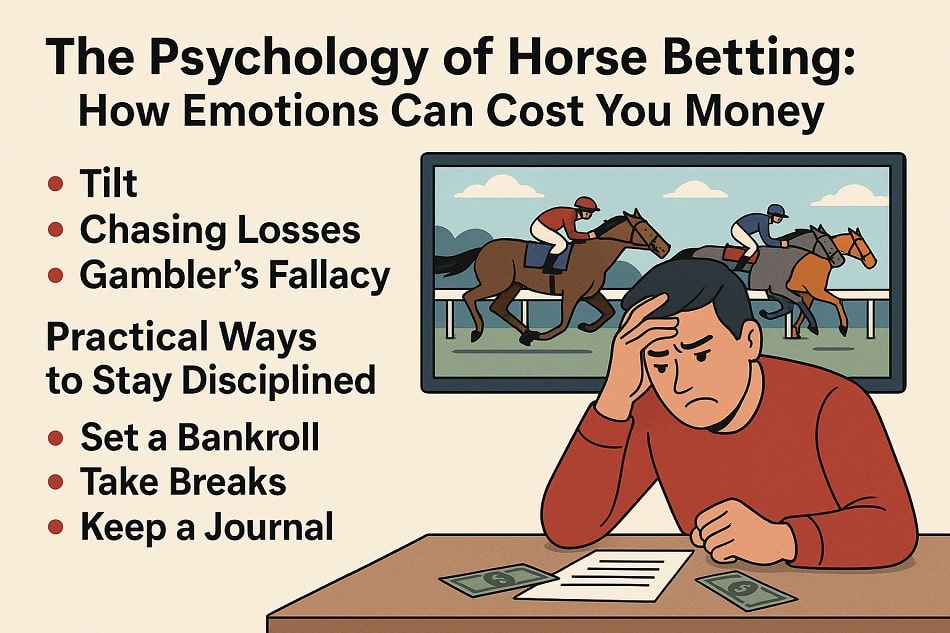
Horse racing is often described as the “Sport of Kings,” but for many bettors it is also the sport of quick thrills and crushing disappointments. A big part of what makes horse betting so exciting is the psychological ride that comes with it. Every race offers hope of a payoff, but emotions can quickly derail even the most experienced bettor. Horse betting combines uncertain outcomes with changing prices and the sensory stimulation of the racetrack environment. A planned selection can quickly become an impulsive wager when the bettor reacts to the previous result. Without awareness and discipline, those emotions can cost you dearly.
In this article, we will explore the key psychological pitfalls that horseplayers face: tilt, chasing losses, and the gambler’s fallacy. We’ll also cover practical planning routines for separating your race analysis from an urge to wager. These are decision checks, not methods that make a losing strategy profitable. Whether you’re a newcomer to the track or a seasoned handicapper, mastering the mental game is just as important as mastering speed figures and past performances.
Why Psychology Matters in Horse Betting
Horse racing is a game of probability, but bettors are human beings. Humans are emotional, biased, and prone to making decisions that defy logic. While handicapping strategies, speed ratings, and trainer angles are all important, none of it matters if emotions dictate your wagers. Psychology is the hidden opponent every bettor faces, and often it is the toughest to beat.
Think of your mind as another horse in the race. If you let it run wild, it can stumble and take you out of contention. But if you train it, focus it, and discipline it, you give yourself a chance to maximize the value of your wagers over time.
Understanding Tilt in Horse Betting
Tilt is a term borrowed from poker, but it applies perfectly to horse betting. Tilt describes the emotional state where frustration or anger causes a bettor to make reckless decisions. At the racetrack, tilt often shows up after a tough loss. Maybe your horse clipped heels in the stretch, or the jockey gave what looked like a poor ride. Suddenly, instead of calmly analyzing the next race, you’re firing off larger bets in an attempt to “get even.”
Common signs of tilt at the track include:
- Doubling or tripling your typical wager size impulsively.
- Betting races you didn’t plan to play.
- Abandoning your handicapping methods because you’re angry or impatient.
- Feeling like the game is “against you” and trying to fight back.
Tilt is dangerous because it puts you in a reactive state rather than a rational one. Instead of making decisions based on probabilities, you’re making them based on emotion. Over the long run, tilt is one of the fastest ways to blow up a bankroll.
Chasing Losses: The Most Common Trap
Another psychological trap is chasing losses. This happens when bettors try to recover lost money by making increasingly risky bets. The logic goes something like this: “I’m down $200 today, so if I just hit this $100 exacta, I’ll be back in the black.” While it might occasionally work, most of the time chasing losses only digs a deeper hole.
Chasing losses is fueled by the mistaken belief that you “deserve” to win back your money, or that you are “due” for a turnaround. In reality, the horses don’t care how much you’ve lost, and probability doesn’t bend to emotion. A previous loss does not make the next selection due to win. Races can share weather, surface conditions or other relevant influences, but your personal losses do not improve a horse’s chance or justify increasing the next stake.
The horses do not know what you have lost, and probability does not bend to emotion.
Signs you are chasing losses include:
- Betting more than your planned stake for the day.
- Switching to unfamiliar bet types (like trifectas or superfectas) hoping for a big score.
- Abandoning your usual track or handicapping style because you’re desperate.
The Gambler’s Fallacy
The gambler’s fallacy is another common mental error in horse betting. Here, the error is treating a run of outcomes as a reason that the opposite result must now occur, without identifying evidence that changes the next horse’s chance. For example, you might think, “Favorites have lost the last five races, so the favorite in this race is due to win.” Or, “The inside post hasn’t won all day, so this time it has to.”
In reality, each race is a fresh set of probabilities. Earlier races can provide information about a changing surface or possible track bias, but that requires analysis of the actual runners, trips and conditions. A string of beaten favorites alone does not create a compensating win that the next favorite is owed.
Smart bettors remind themselves that randomness has no memory. The dice don’t know what was rolled last time, and neither do the horses.
The Role of Overconfidence
Overconfidence is another psychological danger at the track. After a big win, it’s easy to start thinking you have the game figured out. That confidence can lead to larger bets, less careful handicapping, and unnecessary risks. Win percentage depends on the selections, bet types and prices. A high hit rate can still lose money, and a short winning run does not establish an edge after all ticket costs. Humility is essential if you want to survive long term.
Common Betting Biases
- Recency bias: overweighting the latest result.
- Confirmation bias: noticing only evidence that supports a favorite selection.
- Sunk-cost thinking: adding money because earlier research or bets lost.
- Outcome bias: judging a decision only by whether it won.
| Trigger | Question to ask | Planned response |
|---|---|---|
| Loss followed by a larger stake | Was this amount written down before the loss? | Cancel the increase and review the original limit. |
| Unexpected win | Has new race evidence changed, or only my confidence? | Keep the next wager within the existing plan. |
| A runner feels “due” | What specific information changes its chance? | Analyze the race rather than relying on a streak. |
| Pressure to recover money | Would I place this ticket if the earlier bet had not lost? | Stop instead of making a recovery wager. |
| Time or spending limit reached | Has the agreed stopping point arrived? | End the session without adding funds or extending it. |
Practical Strategies to Stay Disciplined
So, how can you avoid falling prey to these emotional pitfalls? Here are some practical strategies to keep your betting discipline sharp:
Set a Bankroll and Stick to It
Decide in advance how much money you are willing to risk in a day or week. Once that money is gone, stop betting. Treat it as entertainment money, not something you need to win back. A written limit provides a clear stopping point; it does not guarantee that you will follow it or make wagering affordable. Keep essential bills and borrowed money outside the betting budget.
Bet in Units, Not Emotions
A unit is a chosen stake amount used for consistent accounting. It is not a universal safe percentage of a bankroll. Define an affordable total limit first, then count the entire ticket cost against it. Multiple small units across several pools can still create a large combined exposure. Feeling confident is not a reason to override the limit.
Take Breaks Between Races
Instead of betting every race, give yourself time to cool down. Walk around, get some fresh air, and reset your mind. This helps prevent tilt from carrying over from one race to the next.
Keep a Betting Journal
Write down your bets, the reasoning behind them, and the results. Over time, patterns will emerge. You may notice that you lose most of your money in late races when tired, or that you bet bigger after losses. Awareness is the first step toward improvement.
Use Technology to Your Advantage
Many online betting platforms allow you to set deposit limits, time limits, or even self-exclusion periods. Use these tools to build guardrails around your wagering.
Practice Mindfulness
A pause before submission gives you time to compare the ticket with your written plan. If you are upset, distracted or trying to recover money, leave the wager unsubmitted. This is a practical decision break, not a treatment or a promise that a breathing exercise will restore control.
Use a Written Stop Rule
Set time, loss and stake limits before the first race. Record the planned bet and reason, then compare it with the actual ticket. Stop when the limit is reached rather than trying to recover losses.
Stories from the Track: Lessons Learned
Every horseplayer has a story about emotions costing them money. One bettor might recall being on tilt after a photo finish loss and then blowing the next three races with impulse bets. Another might remember chasing losses on a rainy day, doubling their bets until their wallet was empty. These stories are painful, but they also serve as reminders of how powerful emotions can be.
On the flip side, disciplined bettors often recall the satisfaction of walking away from the track early when things weren’t going their way, preserving their bankroll for another day. The difference often comes down to mental discipline, not handicapping skill.
How to Recognize When You Need to Walk Away
One of the most important and underrated skills in horse betting is knowing when to stop. Whether you are on a winning streak and feeling invincible, or in the depths of a losing run and desperate for a turnaround, there are moments when continuing to bet is not the rational choice. Choose a stopping rule before the session based on a sum and time commitment you can afford, rather than copying a percentage attributed to professionals. Feeling compelled to continue is a reason to stop even if the numerical limit has not been reached.
Physical cues can also signal that it is time to step back. Tension in your shoulders, rapid heartbeat, or frustration after a near-miss are all signs that emotions have moved to the front seat. If you notice these signals, take a break before placing another wager. A break may help you reassess, but it is not a reason to resume automatically. Keep the original limit in force and end the session if the urge to chase remains.
For more practical tools on managing your funds during an emotional session, read our article on bankroll management for online horse bettors. And if you find yourself repeatedly making the beginner mistakes described in the psychology of chasing and tilt, our guide on beginner mistakes to avoid in online horse betting provides a useful checklist.
Why Discipline is the True Edge
Handicapping is complex. You can spend years studying pace figures, class drops, and trainer statistics, and still lose money if your psychology isn’t under control. Discipline can reduce unplanned exposure, but profitability also requires sound analysis and a favorable price after costs. Avoiding tilt, resisting chasing and checking your assumptions do not turn an unfavorable wager into a positive-value one. Review both the decision process and the full financial record.
Final Thoughts
The psychology of horse betting is both your biggest enemy and your greatest opportunity. If you can master your emotions, you can protect your bankroll, make smarter wagers, and enjoy the sport without unnecessary financial pain. Remember that the horses don’t know, and the track doesn’t care. Your only true opponent is the person you see in the mirror.
Stay disciplined, stay mindful, and let your decisions be guided by logic rather than emotion. A controlled process does not guarantee profit. Its immediate purpose is to keep an optional activity within a written limit and make the decision to stop easier to recognize.
Related research
Continue the Analysis
Horse Betting for Beginners
Start with the race, the ticket, pools, odds, and a sensible first-bet workflow.
ContinueUnderstand Bet Types
Compare straight, exotic, and multi-race wagers before building a ticket.
ContinueLearn to Handicap
Build a repeatable process around form, pace, class, distance, surface, and price.
Continue