
Blinkers On and Off: How Equipment Changes Affect Handicapping
On this page 8 sections
- What are blinkers in horseracing?
- Why do thoroughbred trainers add or remove blinkers?
- How to know if blinkers are being added or removed
- Building a Blinkers Database for Your Target Circuits
- Betting blinkers on or off
- How to Evaluate a Blinker Change
- Compare Focus With the Cost of Extra Speed
- Keep a Testable Equipment-Change Note
Equipment-change caution: blinkers on or off can affect focus and early position, but the direction and size of the effect are not predictable from the notation alone.
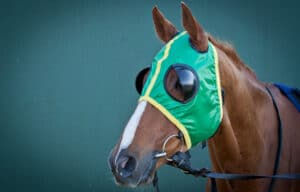 A smart handicapper must always be aware of equipment changes. When a horse adds or removes equipment such as blinkers or bandages, this can have significant meaning. The notation is a prompt to investigate the horse’s behavior and likely trip. It does not reveal a predictable improvement or a betting edge by itself.
What are blinkers in horseracing?
Blinkers are a piece of equipment that are used to restrict a horse’s field of vision. They are composed of a cloth hood and cups which sit behind the horse’s eyes. The cups can come in a variety of sizes. There are quarter cups, half cups, and full cups. The cloth to which the cups are attached is often adorned with the colors of the racing stable to which the horse belongs.
The eyes of a horse are situated on either side of the animal’s head. This gives them a large field of vision. Each horse, however, has a few blind spots. One of these is directly behind the horse’s rear. Another is just a few inches below the nose. When objects such as other horses or humans suddenly appear from one of these blind spots, a horse can become spooked. Their flight animal instincts begin to take over.
Contrary to common belief, all thoroughbred racehorses are not high strung and tense. Many of the most successful racing horses are very calm and trusting of their handlers. Sometimes, however, it can become necessary to use blinkers in order to improve the concentration and focus of the horse so that it can better focus on the task of performing well in a race.
Why do thoroughbred trainers add or remove blinkers?
One of the most common reasons a thoroughbred trainer will add blinkers to a horse is to sharpen early speed. If a horse has been lagging behind in the early stages of a race or breaking slowly from the gate, blinkers can often help to focus the horse’s attention and help them to be more competitive.
The early stages of a race are very important in horseracing. A horse that drops far behind may need a favorable pace and a clear late run. Some horses are effective closers, so being held up is not automatically a defect that equipment must correct. On the other hand, horses who are able to stalk the leaders of a race within a competitive distance such as two or three lengths often do very well. Blinkers may help these horses to produce more early speed and establish a better starting position.
When a trainer removes blinkers, the intention can often be to help the horse relax more during the early stages of a race and use less early speed. Some horses want to immediately burst to the lead. They use too much energy too fast and are unable to finish the race in contention for a win. Sometimes, trainers will remove the blinkers when a horse is “stretching out” or trying a longer distance for the first time. Sprints are races contested at 7 furlongs or less. Routes are longer than 7 furlongs and most often a mile or more in distance. It is important that horses and jockeys in these races are skilled in the assessment of pace.
It is also true that some trainers have their own reasons for adding or removing blinkers. The notation alone does not establish whether the change addresses a specific problem. You should always be aware of the trainer’s stats when making this equipment change. Frequent wins deserve investigation alongside the size of the sample, quality of the horses and prices; they do not explain the reason for this particular change.
How to know if blinkers are being added or removed
The best friend of the handicapper are past performance charts. These charts are often referred to as PPs. They are available in the Daily Racing Form and from other services such as Equibase for a modest fee. The PP gives information about the career of a racehorse in a snapshot. Those who like EZ Horse Betting can then compare the performances of all the horses in a race.
There are many key components in a past performance chart. One of these is a speed figure which is meant to establish a benchmark of how fast a horse has run in the past. There are listings of recent workouts. Finally, there are notations of equipment changes. If a horse is adding blinkers, you will see the words BLINKERS ON in the PP. If blinkers are being removed, you will see BLINKERS OFF. This information is often located next to the horse’s name and is often in bold type.
Another facet of this information that you may see in some PPs is how well a trainer has performed when making this change of equipment. There will often be a small area which states the winning percentage of the trainer. Check the number of starts, period, prices and comparable circumstances before interpreting a percentage.
Building a Blinkers Database for Your Target Circuits
Record the direction of the change, whether it is the first use or a return to earlier equipment, the race conditions and the horse’s recent behavior. Include every qualifying start rather than only successful changes.
Separate trainer results by a clearly defined rule, but do not infer private intentions from a strike rate. Two winners from ten starts is 20%, yet that small sample does not establish a dependable pattern. A high win percentage can also lose money if winners are short-priced.
Record stakes and gross returns alongside results, then test the observation on later races. A database is useful for checking an idea, not proof that blinkers additions generally outperform or that ten examples reliably classify a trainer. For broader context, see horse-racing equipment.
Betting blinkers on or off
First of all, you should determine if the horse has added or removed blinkers in the past. The past performances will provide this information. You can often see how the horse has responded before when a change was made to its equipment. If a horse has won in the past when adding blinkers, they may improve when adding them today. Similarly, if a horse has a history of performing better without blinkers, it may be wise to bet the horse today if the blinkers are coming off.
If a horse has been struggling to remain in contention early, adding blinkers may help the animal establish a better position today. If the horse has run well in the past but simply been too far back to make a good run, the addition of blinkers could help the horse stay closer to the pace.
A horse that has been using too much energy in the early stages of a race could do a better job of conserving energy today if the blinkers are being removed. Sensing the presence of other horses might help him to relax and settle into a good pace.
Finally, compare the trainer’s relevant record with the horse’s individual evidence. A strike rate below 15% does not automatically rule out the runner; prices, sample size and the type of horses involved all matter. A reliable published explanation of the change can add context, but the statistics alone cannot tell you the trainer’s intention.
Likewise, a rate of 20% or more does not prove that this horse will benefit. Separate the observed record from your prediction. Consider whether the change fits a problem visible in the horse’s races and how a different early position would affect its energy use today.
Use the racebook comparison to check research access and eligibility if you are considering an account. Past performances and replays may have access conditions. You can study the equipment change without making a deposit.
How to Evaluate a Blinker Change
- Confirm the official equipment notation.
- Review previous starts with and without the equipment.
- Consider whether the trainer is seeking more focus, speed or relaxation.
- Map how a pace change would affect today’s field.
- Compare the market price with the uncertainty.
Do not bet an equipment change in isolation. Combine it with form, fitness, class, distance, surface and likely trip.
Compare Focus With the Cost of Extra Speed
Imagine a horse that has broken slowly and raced behind rivals in two sprints. Blinkers are added for its next start. A cleaner break is one possible improvement, but it is not the only scenario: the horse might race too keenly or encounter the same traffic after leaving the gate.
Watch the earlier races to distinguish a poor start from a deliberate hold-up ride. Then compare the likely pace today. If several runners already want the lead, extra early speed may increase pressure rather than create an easier trip. Write both outcomes before deciding whether the change is favorable.
When the horse next runs, record the start, settling behavior and finish separately. A better placing does not show which part of the change mattered, and a defeat does not mean the equipment failed. Opposition, surface and distance may have changed as well.
Use the observation to refine a later assessment rather than declaring a universal blinkers-on or blinkers-off rule. The most useful note explains what happened and what remains uncertain.
Keep a Testable Equipment-Change Note
| Stage | Example note | What it does not prove |
|---|---|---|
| Before race | Blinkers added; slow breaks observed | An automatic improvement |
| Prediction | Cleaner break without a pace duel | That the horse will settle |
| After race | Record break, early position and finish | That one win validates the angle |
Use this illustrative log to distinguish what happened from what you expected. If the horse breaks cleanly but weakens after pressing rivals, the equipment prediction may be partly right while the betting decision is wrong. Record final price, every stake and complete return too. Avoid selecting only winning equipment changes for the database; unsuccessful changes are essential to testing whether the observation helps future decisions.
Related research
Continue the Analysis
Horse Betting for Beginners
Start with the race, the ticket, pools, odds, and a sensible first-bet workflow.
ContinueUnderstand Bet Types
Compare straight, exotic, and multi-race wagers before building a ticket.
ContinueLearn to Handicap
Build a repeatable process around form, pace, class, distance, surface, and price.
Continue
i only bet horses without blinkers just from an assesement of always seeing horses in the winner circles with no blinkers on. every now and then one in blinkers will win i understand that just more often then not i see horses without blinkers get the job done.