
Ruffian: Career Record and Racing Legacy
On this page 13 sections
- Official career record
- Breeding and development
- Champion at two
- Reading records accurately
- Key races before the match
- The 1975 New York filly series
- The match race with Foolish Pleasure
- Burial and influence
- Writing about catastrophic injury
- Comparing Ruffian with other great females
- How to study an unbeaten sequence
- Check a Record’s Category and Date
- Read both sides of the historical record
Ruffian won the first 10 races of her career, earned championships at two and three, and set or equaled records while leading at every call. Her eleventh start, a 1975 match race against Kentucky Derby winner Foolish Pleasure, ended with a catastrophic injury. Her record deserves precise language and a respectful account of the final race.
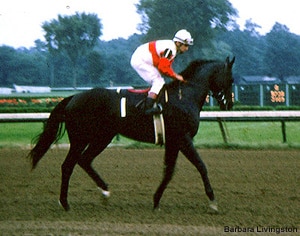
Official career record
The National Museum of Racing and Hall of Fame records 11 starts, 10 wins, no seconds or thirds, and earnings of $313,428. The final match race is included as a start, although Ruffian did not finish.
| Year | Starts | Wins | Campaign | Honor |
|---|---|---|---|---|
| 1974 | 5 | 5 | Juvenile season | Champion 2-year-old filly |
| 1975 | 6 | 5 | Three-year-old season | Champion 3-year-old filly |
| Career | 11 | 10 | $313,428 career earnings | Hall of Fame, 1976 |
Breeding and development
Ruffian was bred by Mr. and Mrs. Stuart S. Janney Jr. and raced for Locust Hill Farm. She was by Reviewer out of Shenanigans, by Native Dancer. Frank Whiteley Jr. trained her, and Jacinto Vasquez rode her through the most famous part of her career.
The nearly black filly attracted attention immediately. She won her 1974 debut by 15 lengths and equaled Belmont Park’s 5½-furlong track record in the Fashion Stakes. She led at every call during her 10 completed races, a rare combination of early speed and the ability to maintain it.
Champion at two
Ruffian won all five juvenile starts. Her victories included the Fashion, Astoria, Sorority, and Spinaway. She set or equaled records during the campaign, but claims that nearly every 1974 record remains unbroken need a current record book and a named cutoff. Records change with timing methods, track configurations, and race conditions.
Ruffian dealt with physical setbacks during the season, including a splint problem and a hind-leg fracture. The documented response was rest and rehabilitation. Her later return should not be used to imply that injury has little consequence or that extraordinary talent makes racing through pain acceptable.
Reading records accurately
Ruffian’s debut and Fashion Stakes established her speed immediately. Later accounts describe stakes and track records across the career, but the category and date matter. A stakes record belongs to a particular race under its conditions; a track record belongs to the venue and distance. Timing equipment and track configuration can later change.
That is why “all but one remain unbroken” is unsuitable as a permanent sentence. A record claim should name the race, time, surface, and the date on which it was checked. Ruffian’s standing does not depend on freezing a 1975 record book forever.
Key races before the match
| Race | Season | What it added |
|---|---|---|
| Fashion Stakes | 1974 | Early speed and an equal track record |
| Sorority Stakes | 1974 | Victory despite a splint problem |
| Spinaway Stakes | 1974 | Completed an unbeaten juvenile campaign |
| Acorn Stakes | 1975 | First race of the New York filly series |
| Mother Goose Stakes | 1975 | Extended the unbeaten sequence |
| Coaching Club American Oaks | 1975 | Completed the series at a longer distance |
The table shows progression without claiming that the fields or conditions were identical. To compare the performances, consult the charts for pace, margin, weight, time, and the quality of each opponent.
The 1975 New York filly series
At three, Ruffian won the Comely Stakes and swept the Acorn, Mother Goose, and Coaching Club American Oaks, the series then known as New York’s Triple Crown for fillies. She won the longer races without surrendering her customary early position.
The sweep secured the championship before the match race. It also provides a better basis for evaluating her than a subjective title such as “greatest filly ever.” Comparisons with other champions require era, distance, opposition, surface, longevity, and the completeness of each career.
The match race with Foolish Pleasure
Ruffian met 1975 Kentucky Derby winner Foolish Pleasure at Belmont Park on July 6. Vasquez had ridden both horses and chose Ruffian; Braulio Baeza rode Foolish Pleasure. The event was designed as a head-to-head contest between prominent champions.
Ruffian sustained catastrophic fractures to her right foreleg during the early part of the race. Vasquez pulled her up, and veterinarians attempted surgical repair. Complications during recovery left no humane treatment option, and she was euthanized early on July 7.
The injury prevented a sporting answer to the match-race question. It should not be described as competitive spirit “costing” Ruffian her life. Horses do not choose the event, veterinary plan, or risks created by racing.
Burial and influence
Ruffian was originally buried in the Belmont Park infield near the finish line. In 2023, her remains were moved to Marchmont Cemetery at Claiborne Farm, as Claiborne’s history records. Whiteley kept her stall empty after her death. She entered the Hall of Fame in 1976 and remains one of the defining American fillies of the twentieth century.
Her death prompted public discussion about equine injury, match-race promotion, surgery, and recovery from anesthesia. Modern safety policy should be described through current veterinary and regulatory sources rather than projected backward from one tragedy.
Writing about catastrophic injury
The necessary facts are that Ruffian sustained catastrophic fractures, received emergency care, experienced further injury during recovery, and was euthanized when treatment could no longer offer a humane outcome. Anatomical detail beyond that can overwhelm the racing history without improving understanding.
Responsible language also avoids turning the horse’s desire to run into blame. The people and institutions around a race make decisions about matchmaking, preparation, veterinary clearance, and treatment. A horse’s behavior is evidence for veterinarians and horsemen, not a moral choice.
Historical tragedy can support a modern discussion of safety when the connection is sourced and dated. It should not be used as promotional drama or followed immediately by a wagering signup pitch.
Comparing Ruffian with other great females
Ruffian’s unbeaten completed-race record, margins, times, and range from sprinting through the filly classics support her place among elite females. Other mares built longer careers, defeated older males, traveled internationally, or won on multiple surfaces. Those are different measures.
A useful ranking states its criteria before naming a winner. If peak dominance carries the most weight, Ruffian scores exceptionally. If longevity and total elite starts dominate, another mare may rank higher. The evidence can sustain admiration without presenting a subjective title as settled fact.
How to study an unbeaten sequence
- List all 10 completed races with distance, field size, margin, time, and opposition.
- Mark whether a time was a track record, stakes record, or equal record on that date.
- Compare the five juvenile races with the five wins at three.
- Separate front-running position from the pace pressure she actually faced.
- Use the final match race only for facts established before the injury; do not invent a likely winner.
Continue through the racehorse profiles, read the surface guide, or record the race evidence in the Race Lab.
Check a Record’s Category and Date
When studying a chart, distinguish the time recorded in that particular race from a later claim that it remains a record. Write the distance, surface, venue, record category and date beside the figure. A later course alteration can make a comparison less direct without changing what Ruffian achieved in the original event.
Read both sides of the historical record
For another horse-specific perspective on the racing history discussed here, read our Foolish Pleasure profile. Comparing biographies helps place individual events within complete careers. Keep confirmed results and contemporary circumstances separate from later opinions about what a different outcome might have been.
Related research
Continue the Analysis
Racehorse Profiles
Explore notable horses, breeds, form, and stories from racing history.
ContinueJockey Profiles
Browse riders, careers, records, and the craft of race riding.
ContinueTrainers & Training
Learn conditioning concepts and browse trainer profiles.
Continue
Every time I find an article online about this legendary filly, knowing what happened to her breaks my heart every time. The only horse I believe that could match her was the mighty Secretariat. Lucien Lauren, Big Red’s trainer, got into hot water once when he said “As God as my judge, she may be even better than Secretariat.” Lauren told reporters that after watching Ruffian win the Spinaway in record time.
You are exactly right! This comment caused Lauren to receive his share of criticism. One can only appreciate the respect he must have had for the great filly. If anyone was in a position to claim that she was better than Secretariat, it was Lucien Lauren.
Thanks for a great comment and visit us again soon!
You’re very welcome! Thank you for having your site. I really appreciate it when people give Ruffian her due. I’d take Mr. Lauren’s word about her ability, no question. He should know. I understand Penny Tweedy was not happy about that comment either, but he was honest. I’ve seen too many over the years dismiss Ruffian as ‘over-rated’ or other such nonsense. I suspect those folks either were too young to see her race or they are old enough to have lost money on her. I don’t bet, but I was privileged to follow her career and I cried when she died.
I see you have an article about another one of my favorites, the infamous Zippy Chippy, He Who Always Finishes Last. I’ve bookmarked your site. I’ll be back soon.
Thanks! If there are any other horses you would like to see added to our pages please feel free to share them and we will see what we can do!
I am always at a loss for words when it comes to the tragedy of Ruffian even after all these years. she was the most beautiful and graceful horse to ever live. her speed and her heart were unmatched. I am of the utmost certainty she would have beaten Foolish Pleasure handily. we got a female golden retriever/collie puppy some month’s after Ruffian’s death and named her “Ruffian” in Ruffian’s honor and memory. so sad even to this day.
Denni,
This is such a touching story. Thank you for sharing your personal tribute to the greatest filly in the history of thoroughbred racing.
If you haven’t seen it we would highly recommend the movie Ruffian starring Sam Shepard as trainer Frank Whitely, Jr. and a stellar cast of real jockeys. The film was shot on location at Louisiana Downs and a nearby training facility which was turned into the backside barn areas of Saratoga, Belmont Park, and Monmouth Park for the filming! The film deeply explores Whitely’s concerns about Ruffian competing in the contest that ended her life.
thanks ez, I did see that movie. I wonder with the new orthopedic technology of today if anything could have been done to save Ruffian. we had a picture of her hanging on our kitchen pantry door. everyone cried that horrible day.
I love Ruffian! Great Horse but sad ending.
Thanks for reading guys. We love her, too. Thanks for stopping by to say hello.
Ruffian and Zenyatta are my two favorite race horses of all. I wonder how she would be incomparison Secratariat.