
Julie Krone: Jockey Profile and Career Record
Julie Krone rode 3,704 winners and became the first woman to win a major North American riding title, a Triple Crown race, a Breeders’ Cup flat race, and induction into the National Museum of Racing and Hall of Fame. Her career ran from 1981 through 2004, and her mounts earned $90,126,584. Those achievements stand as a complete professional record rather than a novelty attached to her gender.
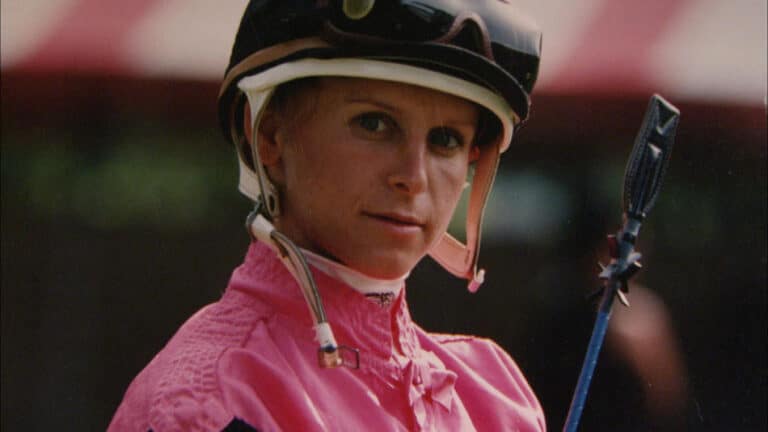
Julie Krone’s official record
The National Museum of Racing and Hall of Fame lists Krone’s career as 1981–2004, with 3,704 wins, $90,126,584 in earnings, and a 17.29 percent win rate. She entered the Hall of Fame in 2000, becoming the first woman inducted.
| Milestone | Record |
|---|---|
| Career | 1981–2004 |
| Wins | 3,704 |
| Mount earnings | $90,126,584 |
| Major-track riding title | 1987 |
| Belmont Stakes | 1993, Colonial Affair |
| Hall of Fame induction | 2000 |
| Breeders’ Cup Juvenile Fillies | 2003, Halfbridled |
From Michigan to the racetrack
Krone was born in Benton Harbor, Michigan, in 1963 and grew up around horses. Her early riding included show and performance disciplines before she pursued race riding. She obtained her jockey’s license and began her professional career in 1981.
She built her record through the same daily work as other riders: accepting mounts, learning horses, maintaining weight and fitness, studying race shape, and establishing relationships with trainers. In 1987, she became the first woman to win a riding title at a major racetrack. She subsequently won titles at Monmouth Park, Meadowlands, Atlantic City, Gulfstream Park, and Belmont Park’s spring meeting.
The 1993 Belmont Stakes
Krone’s victory aboard Colonial Affair in the 1993 Belmont Stakes made her the first woman to ride the winner of an American Triple Crown race. The 1993 Belmont tested the balance between position and energy conservation. Horses arriving for the third leg can have different recent campaigns; participation in the Belmont does not mean that every runner contested both earlier classics.
Colonial Affair and Krone won by 2¼ lengths. The result belonged to a complete team—owner, trainer, horse, rider, and staff—and it established a milestone no woman had previously reached in the series. Winning a single leg of the series is distinct from completing the Triple Crown. Colonial Affair’s Belmont success established the riding milestone without a sweep of the three races.
Hall of Fame and Breeders’ Cup firsts
The Hall of Fame inducted Krone in 2000. Three years later, she rode Halfbridled to victory in the Breeders’ Cup Juvenile Fillies, becoming the first woman to win a Breeders’ Cup flat race. Halfbridled broke from the outside post and still delivered an unbeaten championship season.
Krone’s other major mounts included Hall of Famers Safely Kept and Housebuster, champion Rubiano, and stakes winners Candy Ride, Da Hoss, Tale of the Cat, Peaks and Valleys, Sweet Return, and Lite the Fuse. Her major victories included the Pacific Classic, Hollywood Derby, Man o’ War Stakes, Sword Dancer Invitational, Fountain of Youth, and multiple editions of the Shadwell Turf Mile and Queen Elizabeth II Challenge Cup.
Injuries, retirement, and the completed career
Race riding brought serious injuries as well as wins. Krone returned from several setbacks during her career, including a severe spill at Saratoga in 1993. She initially retired in 1999, returned to riding in 2002, achieved the Halfbridled and Candy Ride milestones in 2003, and retired from professional race riding in early 2004. The Hall of Fame therefore records the full span as 1981–2004.
Her Hall of Fame induction came between the two riding periods. The 2003 successes therefore expanded a record that had already earned the sport’s highest recognition. Returning from retirement meant rebuilding competitive opportunities as well as getting back into the saddle.
How to study a jockey without stereotypes
Krone crossed barriers while developing the same practical skills required of other leading riders. Her racing record opens useful questions: Which horses did she ride well? How did she handle pace, traffic, and position? Which trainer relationships produced opportunities? How did she perform across circuits and surfaces?
Gender alone cannot explain a ride or predict a result. Nor can fame. A bettor should begin with the horse and race, then assess whether the rider’s recent and relevant evidence changes the probability enough to matter at the offered odds.
Worked replay exercise
Use Colonial Affair’s 1993 Belmont or Halfbridled’s 2003 Breeders’ Cup Juvenile Fillies for a structured replay study:
- Write the horse’s post, public odds, usual running style, and the expected early pace.
- At the break, record whether the rider asks for speed or allows the horse to settle.
- At each call, note position, path, traffic, and approximate ground loss.
- Identify the decisive move and whether it came in response to another runner.
- Separate what the replay proves from what you infer about instructions or confidence.
Then study a loss. If the same note-taking method produces a plausible explanation in both cases, it is more useful than a conclusion built only from the winner. Connect the observations to the jockey profiles and the site’s handicapping guide.
Using current jockey statistics
When evaluating an active rider, choose a defined date range and filter for today’s track, surface, distance range, and trainer partnership. Record starters, wins, in-the-money finishes, average odds, and equal-stake return. Small samples and short-priced mounts can make a win percentage look more predictive than it is.
Krone’s career remains historically important because the milestones were supported by thousands of wins and success in the most competitive races. Studying that record should sharpen how readers evaluate race riding, while the final wagering decision still depends on the current horse, conditions, and price.
Halfbridled and the Outside Draw
Halfbridled’s 2003 Juvenile Fillies offers a concrete example of managing an awkward starting position. She drew post 14 at Santa Anita. In the post-race press conference, the discussion focused on the wide trip and Krone’s confidence in the filly’s ability. A successful result did not make the extra ground disappear.
An outside post creates choices: use speed to seek position, stay outside with clear running room, or drop behind runners to move inward. Each has a cost. Sending early can spend energy; staying wide adds distance; dropping back can leave traffic to negotiate. There is no single instruction that suits every horse breaking from the same stall.
Halfbridled’s win therefore illustrates the difference between overcoming a disadvantage and proving that the disadvantage does not matter. The Breeders’ Cup profile identifies Krone’s milestone specifically in a non-steeplechase race. That distinction preserves the achievement while keeping the event’s broader history accurate.
Read the Draw Alongside the Trip
A horse wins from an outside post after racing wide. Does the win establish that the post caused no disadvantage?
Reveal the worked answer
No. The result shows the horse won despite the trip described. It does not measure what would have happened with a different draw or prove that every horse can overcome the same ground loss. Compare the path, early effort, pace and opposition before turning one successful ride into a general rule.
On this page 10 sections
- Julie Krone’s official record
- From Michigan to the racetrack
- The 1993 Belmont Stakes
- Hall of Fame and Breeders’ Cup firsts
- Injuries, retirement, and the completed career
- How to study a jockey without stereotypes
- Worked replay exercise
- Using current jockey statistics
- Halfbridled and the Outside Draw
- Read the Draw Alongside the Trip
Related research
Continue the Analysis
Racehorse Profiles
Explore notable horses, breeds, form, and stories from racing history.
ContinueJockey Profiles
Browse riders, careers, records, and the craft of race riding.
ContinueTrainers & Training
Learn conditioning concepts and browse trainer profiles.
Continue