
Silver Charm – Competitive Racehorses of all Time
On this page 16 sections
- Breeding and Sale History
- Two-Year-Old Season
- The 1997 Kentucky Derby
- Preakness Victory
- The Belmont Near-Miss
- Dubai World Cup Season
- A Record Built on Narrow Margins
- Correct 1999 Record
- Retirement, Japan, and Old Friends
- Year-by-Year Racing Record
- What “Competitive” Means
- Do Fresh Belmont Runners Have an Automatic Edge?
- Handicapping Lessons From the Record
- Silver Charm Research Checklist
- Read the Four Seasons Together
- Silver Charm’s Four Racing Seasons
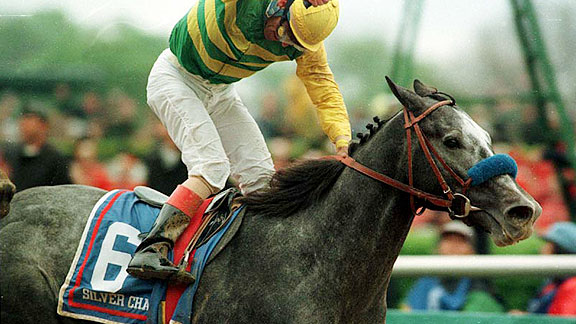
Silver Charm was a durable, determined gray whose narrow victories made him one of the most popular American racehorses of the late 1990s. He won the Kentucky Derby and Preakness, finished second in the Belmont, captured the Dubai World Cup, and retired with 12 wins from 24 starts.
Breeding and Sale History
Silver Charm was foaled in Florida in 1994. He was by Silver Buck, winner of the Suburban and Whitney handicaps, and out of Bonnie’s Poker, by Poker. Mary Lou Wootton bred him.
He sold for $16,500 as a yearling to pinhookers Randy Hartley and Dean De Renzo. C. J. Grey later purchased him for $30,000, then bought him back when he failed to meet a $100,000 reserve at a two-year-old sale. After Bob Baffert reviewed a presale workout, Bob and Beverly Lewis acquired the colt privately for $85,000.
This sequence is more precise than saying his parents had only a slim chance of producing a champion. Breeding outcomes are uncertain, but an individual probability cannot be reconstructed from pedigree reputation and sale price alone.
Two-Year-Old Season
Silver Charm finished second in his debut at Del Mar and broke his maiden in his next start on August 24, 1996. He followed with a narrow victory in the Del Mar Futurity. Baffert then gave him time before the 1997 classic campaign.
The 1997 Kentucky Derby
Silver Charm began his three-year-old season by winning the San Vicente Stakes. He then finished second to Free House in the San Felipe and Santa Anita Derby.
In the Kentucky Derby, Silver Charm and jockey Gary Stevens defeated Captain Bodgit by a head. The close finish reflected a recurring feature of his career: he often prevailed after prolonged competition rather than separating easily from the field.
Preakness Victory
Silver Charm won the Preakness by a head over Free House, with Captain Bodgit another head behind. He entered the Belmont with a chance to become the first Triple Crown winner since Affirmed in 1978.
The Belmont Near-Miss
Silver Charm took the lead in the Belmont stretch but Touch Gold passed him late and won by three-quarters of a length. The result belongs among the notable Triple Crown near-misses, but the surrounding “fresh horse” story must be accurate.
Touch Gold skipped the Kentucky Derby but did not skip both earlier legs. He ran fourth in the Preakness after a difficult start. Describing him as a horse that bypassed the Derby and Preakness to arrive untouched at the Belmont is factually wrong.
Silver Charm finished his 1997 season with three wins and four seconds from seven starts and received the Eclipse Award as Champion Three-Year-Old Male.
Dubai World Cup Season
At four in 1998, Silver Charm won six of nine starts. His season included the Strub Stakes, San Fernando Stakes, Dubai World Cup, Kentucky Cup Classic in a dead heat, Goodwood Breeders’ Cup Handicap, and Clark Handicap.
He finished second to Awesome Again in the Breeders’ Cup Classic. The Dubai World Cup nose victory over Swain remains his best-known international performance.
A Record Built on Narrow Margins
Silver Charm won the Derby and Preakness by a head and the Dubai World Cup by a nose. Those finishes support his reputation for persistence in close competition. They also show why a result should be read with the trip, pace, rivals, and actual margin.
A narrow win is still a win, but it does not prove the horse would repeat the result under every pace or at every price. The full sequence is more informative than a single dramatic replay.
Correct 1999 Record
Silver Charm made five starts in 1999, not six. He won the San Pasqual Handicap once, finished third twice, and ended his career after finishing fourth in the Stephen Foster Handicap.
His complete record was 12 wins, seven seconds, and two thirds from 24 starts, with earnings of $6,944,369. The National Museum of Racing’s official Silver Charm profile provides the year-by-year record and race chronology.
Retirement, Japan, and Old Friends
Silver Charm entered stud in Kentucky and later stood in Japan. He returned to the United States in 2014 and retired to Old Friends, the Thoroughbred retirement farm in Georgetown, Kentucky. The National Museum elected him to the Hall of Fame in 2007.
Continuing the story past his final race matters because retirement, international breeding, repatriation, and public life at Old Friends became significant parts of his legacy.
Year-by-Year Racing Record
- 1996: two wins and one second from three starts
- 1997: three wins and four seconds from seven starts
- 1998: six wins and two seconds from nine starts
- 1999: one win and two thirds from five starts
The seasons add to 12 wins, seven seconds, and two thirds from 24 starts. Presenting all four prevents the incorrect 1999 sentence from hiding inside an otherwise correct career total.
What “Competitive” Means
Calling Silver Charm one of the most competitive horses of all time is an opinion, not a measurable career category. The underlying evidence is clearer: 21 in-the-money finishes from 24 starts, graded-stakes wins in all four racing seasons, repeated narrow victories, and major success in two countries.
Use those facts and let readers decide where he belongs among champions. Avoid converting temperament or courage into a precise probability that the record cannot supply.
Do Fresh Belmont Runners Have an Automatic Edge?
Silver Charm’s loss cannot validate a reliable system. Touch Gold had run in the Preakness, and one result does not show how an entire category performed relative to its odds.
To test the claim, define “fresh,” include every Belmont starter over a fixed period, and record prior Triple Crown participation, final odds, stake, finish, and return. Compare equal-unit results and test the rule on later years. Separate temporary Saratoga editions from the traditional 1½-mile Belmont Park race.
Handicapping Lessons From the Record
Silver Charm’s career shows why pace, trip, distance, and competition matter alongside finishing position. His close wins reveal repeated ability under pressure; his Belmont loss shows how a new rival and longer distance can change the outcome; his Dubai victory demonstrates successful travel.
Historical admiration does not identify a current wager. For today’s race, estimate each horse’s probability range, compare it with the live price, calculate the complete ticket, and use only discretionary money.
Silver Charm Research Checklist
- Use the complete 24-start record.
- Correct the 1999 season to one win from five starts.
- Record that Touch Gold ran in the Preakness.
- Separate evidence of competitiveness from superlatives.
- Continue the chronology through stud retirement and Old Friends.
Continue with the profiles of Bob Baffert and Gary Stevens, plus the current guides to the Kentucky Derby and Belmont Stakes.
Read the Four Seasons Together
The National Museum of Racing’s career record lists Silver Charm as a graded-stakes winner in each of his four racing years, from 1996 through 1999. His near miss in the 1997 Belmont is only one part of that record: he won six of nine starts in 1998, compared with three of seven in 1997. That later campaign helps explain why the story continued beyond the Triple Crown attempt.
Use the year-by-year table to separate starts, wins and earnings rather than judging the career from a single famous loss. When comparing horses historically, remember that purses and race programs differ by period; the record shows performance within its own competition, not a universal ranking by dollars won.
Silver Charm’s Four Racing Seasons
| Year | Starts | Wins | Seconds | Thirds |
|---|---|---|---|---|
| 1996 | 3 | 2 | 1 | 0 |
| 1997 | 7 | 3 | 4 | 0 |
| 1998 | 9 | 6 | 2 | 0 |
| 1999 | 5 | 1 | 0 | 2 |
| Career | 24 | 12 | 7 | 2 |
Source: the National Museum of Racing career record. His largest number of wins came in 1998, after the Triple Crown campaign. The table makes the full career easier to compare with the race-by-race narrative.
Related research
Continue the Analysis
Racehorse Profiles
Explore notable horses, breeds, form, and stories from racing history.
ContinueJockey Profiles
Browse riders, careers, records, and the craft of race riding.
ContinueTrainers & Training
Learn conditioning concepts and browse trainer profiles.
Continue