
The Golden Slipper Stakes Australian Horse Race
On this page 6 sections
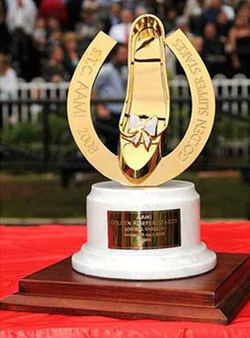 The racing circuit in Australia features many prominent races throughout the year. The Melbourne Cup and the Cox Plate are two of the most popular. Also important is the Golden Slipper Stakes that is held in March. The race attracts some of the most promising two-year-old race horses in Australia, and its 2019 purse was A$3,500,000; the Australian Turf Club listed A$5,000,000 for the 2026 running. Let’s take a closer look at this important Australian horse race.
About the Golden Slipper Stakes
The Golden Slipper Stakes is presented by the Australian Turf Club. It is considered a Group I stakes event. This means that it is typically reserved for the best horses in Australia. The race is contested at a distance of 1,200 meters. In traditional fashion the race is run on turf at the Rosehill Gardens Racecourse. In the article’s original 2018 sponsorship reference, the Golden Slipper Stakes is sponsored by Longines. The company also sponsors important races in America like the Kentucky Derby.
The very first Golden Slipper Stakes was contested in 1957. The victor that year was a horse named Todman. The sire of Todman was Star Kingdom, a horse that became particularly successful at stud. The offspring of Star Kingdom would go on to win the first five runnings of the Golden Slipper Stakes. The Star Kingdom bloodline is still popular in Australia today, and many of the stud’s offspring regularly win important races in Australia.
In 2009 a decision was made to host the race on the first Saturday in April. It precedes the Kentucky Derby by about one month. The race is now part of what has become known as the Golden Slipper Carnival. The 2019 running took place on March 23. The published 2026 program scheduled it for March 21; dates should always be read with their year. Adjustments to the date have been common since 2014.
The race is restricted to two-year-old horses. Colts, geldings and fillies can compete under the race conditions. A colt is a young male horse, while a stallion at stud is used for breeding; those terms are not interchangeable. Compare the conditions and weight allowances rather than assuming juvenile fillies cannot compete against males.
The Golden Slipper Racing Carnival
The Golden Slipper Stakes is the marquee event of the much larger Golden Slipper Racing Carnival. This event features several days of high quality horse racing. It is presented by the Australian Turf Club at Rosehill Gardens in Sydney’s West. This track is one of the most beautiful top be found in Australia.
Rosehill Gardens was described in the original article as having undergone a $28 million dollar refurbishment. New indoor and outdoor areas have been created, and WiFi is available throughout the racing complex. The new venue has also become popular for hosting other major events in Sydney.
Betting the Golden Slipper: Key Handicapping Considerations
The Golden Slipper presents unique handicapping challenges because the horses involved are two-year-olds with limited racing histories, making traditional form analysis less reliable than in races for older, more exposed horses. The emphasis shifts toward preparation pattern assessment — how horses have been brought along by their trainers, the quality of their trial performances, and their physical appearance and demeanour in the days leading up to the race. Trainers with strong records in preparing two-year-olds for major juvenile races deserve additional weight when their runners enter the Golden Slipper with promising trial performances.
Speed is paramount in the Golden Slipper given the six-furlong distance, and barrier position matters enormously at Rosehill — horses drawn wide in large fields face a genuine structural disadvantage in a short-distance sprint where there is limited time to recover from a poor early position. Historical barrier statistics at Rosehill for sprint races provide a useful baseline, though the specific field composition in any given year can modify the relevance of draw significantly. An inside-drawn front-runner may save ground, while a wide-drawn horse can face a difficult early decision. However, competing speed, the track condition and the available odds can reverse that apparent advantage. This is a pace question to test against the field, rather than a demonstrated profitable rule. For more on Australian racing’s premier juvenile event, our article on the Golden Slipper Stakes covers the race in full detail. And our guide to racing horse betting in Australia provides the broader context.
Australian Jockeys and Trainers in the Golden Slipper Stakes
There are a few jockeys and trainers that have amassed multiple wins in this Australian stakes race for horses. Among these are trainer T.J. Smith, whose six wins form an important part of the race’s history. Smith has managed to capture the event six times in his career. This is no small feat when you consider the fragile and inconsistent nature of two-year-old horses.
Other trainers that have good records in the Golden Slipper Stakes include Gai Waterhouse, who had reached eight wins by Lady Of Camelot’s 2024 victory, including two in partnership with Adrian Bott. Waterhouse is considered to be one of the best conditioners of young horses in Australia. Bart Cummings, Lee Freedman, and Clarry Conners are staking their own claim on the race with four wins each.
As for jockeys, Shane Dye and Ron Quinton have won the race four times each. This is similar to jockeys in the US that have won multiple runnings of the Kentucky Derby.
Would you like to watch and wager on the Golden Slipper Stakes? You can do that when you create an account with one of our recommended online horse betting sites. Eligible customers may qualify for a welcome horse betting bonus when you sign up, and some racebooks will even allow you to make Bitcoin deposits.
Related to Australian horse racing:
- 10 Amazing Facts About Australian Horse Racing
- The Australian Racing Board
- Flemington Racecourse In Melbourne, Australia
- Doomben Racecourse, Brisbane
- Eagle Farm Racecourse, Brisbane
- The Melbourne Cup – Australias’s Biggest Horse Race
- The Cox Plate Australian Horse Race
- Timeform Ratings & Australian Horse Racing
- The Golden Slipper Stakes Australian Horse Race
- Phar Lap – The Sad End Of Australia’s Greatest Race Horse
- Top 10 Legendary Australian Race Horses
- The Australian Racing Hall Of Fame
- The Best Way To Bet Horse Races From Australia
- Australian Racing Terms You Need To Know
- 5 Reasons To Bet Australian Horse Racing
- Top 10 Jockeys In Australian Horse Racing
- Picking Horse Race Winners In Australia
Check the current Golden Slipper conditions
The Golden Slipper is a 1,200-metre Group 1 race for two-year-olds at Rosehill. Its purse, sponsor, qualification path and race-day program can change, so the A$3.5 million figure and 2018 sponsorship reference above are historical, not a current offer. Use the Australian Turf Club for the current race conditions, nominations, barrier draw and final field before planning a visit or a wager.
Two-year-old form can develop quickly. Compare each runner’s experience at similar sprint distances, the strength of the opposition, the barrier and the likely first 400 metres. A fast trial can indicate readiness but is not the same evidence as a contested race. Note late scratches and track rating before the jump; both can materially change the expected early pace and the value of a selection.
Golden Slipper conditions at a glance
| Item | 2026 published conditions | Before using the information |
|---|---|---|
| Date and venue | 21 March 2026, Rosehill Gardens. | Use a later official program for a future running. |
| Class and field | Group 1, two-year-olds, set weights. | Check nominations, eligibility, final acceptances and allowances. |
| Distance and surface | 1,200 metres on turf. | Review the race-day track rating and scratches. |
| Prize money | A$5 million in the published program. | Separate the purse from admission prices and betting promotions. |
Source: ATC 2026 Sydney Autumn program. The ATC history timeline provides context for past winners and Waterhouse’s record. For form study, distinguish a horse’s demonstrated race pace from a trial time: trials may involve different pressure, instructions and track conditions. Assess the price after building a pace map, rather than selecting solely by barrier number.
Related research
Continue the Analysis
Major Racing Events
Explore Triple Crown races, championships, festivals, and international meetings.
ContinueRacetrack Guides
Learn how layout, surface, configuration, and conditions shape a race.
ContinueHandicapping Library
Study form, pace, class, figures, distance, surface, and price.
Continue