
Garrett Gomez – Jockey
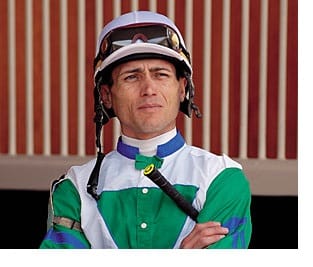
Garrett Gomez was one of the leading North American jockeys of his era. He won 3,769 races, his mounts earned $205,224,899 in purses, received consecutive Eclipse Awards, and won 13 Breeders’ Cup races before his career concluded in 2013.
From the Southwest to Major Circuits
Gomez was born in Tucson, Arizona, in 1972 and learned about race riding from his father, Louie Gomez. He began riding professionally at Santa Fe Downs in 1988 and won his first race aboard Furlong Circle on August 19 of that year.
He won 182 races as an apprentice in 1989, the second-highest total among apprentices. Success in Nebraska, Illinois, and California followed. His major-race progress included consecutive Arkansas Derby wins with Concern in 1994 and Dazzling Falls in 1995.
Riding Titles and Stakes Record
Gomez became a leading rider in Southern California, winning four Hollywood Park titles as well as titles at Santa Anita and Oak Tree. He also led Keeneland’s 2010 Spring Meet.
In 2007, he established a North American record with 76 stakes victories. Thirteen were Grade 1 races, including the Kentucky Oaks aboard Rags to Riches and the Haskell Invitational with Any Given Saturday.
Eclipse Awards and Earnings Leadership
Gomez received the Eclipse Award for Outstanding Jockey in 2007 and 2008. He led North American riders in purse earnings for four consecutive years from 2006 through 2009. His mounts earned a career-best $23.3 million in 2008.
Breeders’ Cup Record
His 13 Breeders’ Cup wins included the Mile with Artie Schiller, two Sprints with Midnight Lute, the Ladies’ Classic with Life Is Sweet, and the Juvenile Fillies with Beholder. His best-known victory came in the 2010 Classic, when Blame defeated the previously unbeaten Zenyatta.
Gomez received the Bill Shoemaker Award for outstanding jockey performance at the Breeders’ Cup four times. His final Breeders’ Cup win came with Beholder in 2012.
Retirement and Hall of Fame
Gomez stepped away from racing during 2013 and announced his retirement in 2015. He died in Tucson on December 14, 2016, at age 44. The National Museum of Racing and Hall of Fame inducted him in 2017.
The dates, totals, and achievements in this retrospective come from the museum’s official Garrett K. Gomez profile.
How to Read a Historical Jockey Record
A career total documents achievement; it does not select a horse in a current race. For active riders, compare starts, mount quality, race conditions, circuit, prices, and equal-unit returns. A celebrated name does not erase concerns about class, surface, distance or pace. Price is a separate issue: a capable horse may still be a poor wager when the odds are too short.
Four Breeders’ Cup Wins in One Year
Gomez’s 2008 Breeders’ Cup results show the range behind the headline total. He won the Filly and Mare Sprint with Ventura, the Dirt Mile with Albertus Maximus, the Sprint with Midnight Lute and the Juvenile with Midshipman. The Hall of Fame record lists all four rather than treating them as one championship performance.
These were separate horses in separate races. Midnight Lute was repeating a Sprint victory from 2007, while the other three wins added different divisions to Gomez’s record. Reading the names alongside the race titles makes a career total more informative: it reveals success with both experienced runners and two-year-olds, rather than implying one specialist horse supplied every win.
The purse total also needs the right label. It measures money won by the horses he rode; it is not his salary or personal take-home pay. Similarly, a stakes win is a subset of his total wins, and a Grade 1 win is a subset of stakes wins. Those categories overlap and should not be added together to create a larger career total.
Continue with Jerry Bailey’s career for another major Breeders’ Cup record, or use the jockey handicapping guide to connect rider statistics with a current race.
Related research
Continue the Analysis
Horse Betting for Beginners
Start with the race, the ticket, pools, odds, and a sensible first-bet workflow.
ContinueUnderstand Bet Types
Compare straight, exotic, and multi-race wagers before building a ticket.
ContinueLearn to Handicap
Build a repeatable process around form, pace, class, distance, surface, and price.
Continue