
American Pharoah Wins The First Grand Slam
Historical recap: October 31, 2015. American Pharoah completed the Triple Crown and Breeders’ Cup Classic in the same season. “Grand Slam” here refers specifically to that four-race achievement.
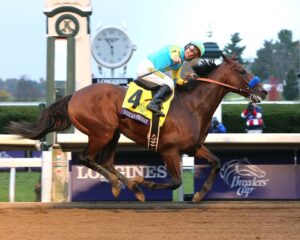 The fairytale story of American Pharoah continued on October 31, 2015 with a victory in the Breeders’ Cup Classic at Keeneland Racecourse in Kentucky. American Pharoah struck the lead early in the race and dominated throughout, drawing off to win by multiple lengths and complete a landmark American racing achievement. Greatest-of-all-time rankings remain matters of comparison and judgment, not an official consequence of the result.
Prior to the race the connections of American Pharoah were very emotional. The Classic was his final race before retirement to stud at Coolmore’s Ashford operation in Kentucky. Private contract terms should not be inferred beyond what the connections publicly announced. For owner Ahmed Zayat and trainer Bob Baffert the race brought a bittersweet end to their partnership with the star horse. Pharoah made the ten mile trip from Keeneland to the Coolmore stud farm the day after he became the first horse to win what is being called the Grand Slam of Horseracing.
What American Pharoah’s Grand Slam Means for Racing History
American Pharoah’s achievement of winning the Triple Crown and the Breeders’ Cup Classic in the same year — completing what has been called the Grand Slam of American racing — was unprecedented in 2015. Its rarity is established by the historical record, but the claim that it may never recur is a prediction. The physical and competitive demands of campaigning at championship level through the Triple Crown series and then maintaining peak condition through to the October 31, 2015 Breeders’ Cup Classic represent an extraordinary test of equine durability and the management skill of trainer Bob Baffert and his team.
From a betting perspective, an exceptional performance and a good pre-race price are separate questions. A short-priced favourite can win decisively while still offering a poor price relative to its estimated chance. Conversely, a losing wager can have been reasonable at the odds available. The outcome alone does not settle the value assessment.
The original claim that American Pharoah was the shortest-priced Classic favourite in the race’s history should not be treated as an established record. Other editions have also featured heavily backed favourites. Likewise, a dominant favourite generally leaves a larger share of the implied chances for itself and longer prices for rivals, rather than automatically suppressing every rival’s price.
To study the 2015 race as a betting example, retain the pre-race assessment, actual tote price, field and ticket stake. Compare the expected race shape with the replay and chart after the event. A winning selection can be part of a useful record without demonstrating a repeatable edge.
Read American Pharoah’s Triple Crown recap and the Triple Crown explained for the earlier races. Our 2021 Breeders’ Cup article is a separate historical edition and should not be mistaken for the 2015 Classic programme.
Horseracing’s first Grand Slam champion
For years the standard of highest excellence in horseracing has been the Triple Crown which consists of the Kentucky Derby, Preakness Stakes, and Belmont Stakes. Only a handful of horses have ever completed the sweep and the last one to do it before American Pharoah was Affirmed in 1978. The series is difficult and very hard on young horses.
When Affirmed won the Triple Crown in 1978 there was no Breeders’ Cup Classic. The Classic has been used in recent years to solidify the best horse in horseracing. American Pharoah was the first Triple Crown winner to have an opportunity to race in the Classic and the industry was quick to create a new designation, the Grand Slam, for horses that win all four races.
After the race jockey Victor Espinoza was so choked up he could barely speak to Donna Brothers as she attempted to interview him as he sat on American Pharoah’s back for the last time. Espinoza will also go down in the record book as the first jockey to win the Grand Slam.
Life at stud after the 2015 finale
Retirement changed American Pharoah’s role from racehorse to breeding stallion. Stud management involves veterinary care, exercise and a breeding schedule; it should not be described simply as unrestricted leisure. Coolmore’s published pedigree and racing record provides career context.
A successful racing record attracts breeding interest, but it does not guarantee the quality of every offspring or establish a horse’s future health. Distinguish the documented racing achievement from predictions about stud life, and consult the current stud’s official information for visiting arrangements and breeding details.
All of us at EZ Horse Betting would like to thank American Pharoah for giving us a year of memories that will last a lifetime! Don’t forget to check out the racebook Reviews! Check our Bovada racebook review, Twinspires review or even our Betamerica review for product or historical research, subject to current service status and local eligibility. online racebook comparison subject to authorization in your location.
What the Grand Slam label means here
In this context, “Grand Slam” means the Kentucky Derby, Preakness Stakes, Belmont Stakes and Breeders’ Cup Classic in the same year. American Pharoah completed that sequence in 2015. The Breeders’ Cup historical record lists his Classic win at Keeneland by 6½ lengths in 2:00.07. Those details establish the sporting record without requiring a claim that he was definitively the greatest racehorse of all time.
That final Classic was a different test from the three-year-old Triple Crown races: it came later in the season against an older-horse field. Compare the field, pace, surface and condition of each event before drawing a single performance ranking. The phrase “may never be repeated” is an expression of how rare the achievement felt, not a prediction that can be proved.
Read the four races as separate tests
| Race | Place in the sequence | Why context matters |
|---|---|---|
| Kentucky Derby | First Triple Crown leg. | Large three-year-old field and a distinct pace and trip. |
| Preakness Stakes | Second Triple Crown leg. | Short turnaround and a different field and racecourse. |
| Belmont Stakes | Third Triple Crown leg. | The 2015 race was a mile and a half at Belmont Park. |
| Breeders’ Cup Classic | October 31 finale at Keeneland. | Older rivals; 6½-length win in 2:00.07 in the official record. |
A combined accolade describes the sequence; it does not make the four performances numerically interchangeable. Compare official charts, surface conditions, opposition and trip before ranking a single race or using it to assess a later runner.
Related research
Continue the Analysis
Horse Betting for Beginners
Start with the race, the ticket, pools, odds, and a sensible first-bet workflow.
ContinueUnderstand Bet Types
Compare straight, exotic, and multi-race wagers before building a ticket.
ContinueLearn to Handicap
Build a repeatable process around form, pace, class, distance, surface, and price.
Continue