
Dynaformer Racehorse
On this page 6 sections
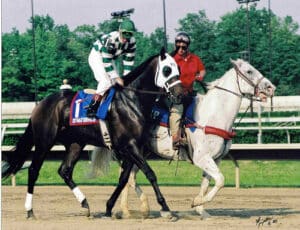 Great racehorses can achieve fame on the racetrack or at stud once their career is over. Some rare champions manage to do both. The legendary Dynaformer was one of these exceptional animals. While only winning 7 of his 30 career starts, Dynaformer earned more than $600,000 in purse money. His success as a competitor was only a prelude to what he would accomplish as a leading sire.
A Tale of Two Racing Giants
Dynaformer was bred by Joseph Allen. It did not take long to realize the horse was going to be huge in stature. By the time he reached racing age, the colt was 17 hands tall. That is 68” in height or 5’8” at the withers, a point at the base of the neck between the shoulders. When Dynaformer’s head was held high, a human more than six-feet tall would have had to look up at him.
By all accounts, Dynaformer was known for his imposing size. He developed a reputation for intimidating his handlers. His owner, Paul Lynn, knew that training the horse would require a trainer who was just as stubborn and demanding. He turned to D. Wayne Lukas, a no-nonsense horseman known for his gruff demeanor and no-nonsense training style. Lukas had once been a high school basketball coach. Dealing with difficult athletes was his stock in trade.
Even so, Lukas found himself challenged by Dynaformer. Lukas stated that the horse was the most difficult one he ever trained. While thoroughbreds have a reputation for being high strung, the reality is that many are calm and easily handled. Dynaformer, however, lived up to the reputation of a racing champion. He was often irritable and surly, sometimes refusing the instructions of his handlers and exercise riders. His demeanor could range from mildly irritable on a good day to excessively hostile on a bad one. Unfortunately, there were more bad days than good from all accounts.
Lukas was patient. This is a skill the Hall of Fame trainer is known for. Individual development depends on ability, experience and preparation; one first-start pattern cannot describe every horse in Lukas’ stable. Dynaformer developed through training for horseracing. As the colt trained under Lukas’ leadership, he began to evidence the traits of a champion.
The Racing Career of Dynaformer
Mildly impressive in his first starts, Dynaformer blossomed at three years of age. His first major win came in 1988 when he won the Grade II Jersey Derby at the age of three. This victory was followed with wins in the Grade II Discovery Handicap and the Lucky Draw Stakes.
Dynaformer made only 30 starts in his career, winning seven times. He was also second five times and third twice. While the horse certainly performed better than the average horse, he was not destined to achieve the level of greatness accorded to Seattle Slew or other champions to which he was often compared.
Dynaformer began his stallion career at Wafare Farm before moving to Three Chimneys for the 1995 breeding season. His reputation grew through the runners he produced, rather than beginning with the prominence he would later achieve.
Dynaformer as a Stud
When the big horse arrived at Three Chimneys, he immediately resumed his troublesome ways. One employee of the farm stated that Dynaformer commanded respect at all times. It was not wise to turn one’s back on him for any length of time.
Accounts of Dynaformer emphasize a difficult temperament and the respect required from experienced handlers. Those anecdotes concern one stallion, not all Thoroughbreds. Breeders nevertheless sought his proven bloodline, and his advertised fee reached $150,000 in 2012. A historical fee describes that season’s market rather than a current service or valuation.
It didn’t take long before champions began to emerge from Dynaformer’s breedings. He sired English champions Lucarno and Blue Bunting. The winner of the Melbourne Cup and Australian champion Americain was one of his sons. It was a horse named Barbaro, however, who captured the hearts of racing fans and thrust Dynaformer into the spotlight as a sire.
Barbaro was foaled in 2003 and went on to amass an undefeated record before being tragically injured in the running of the 2006 Preakness Stakes. The injury would culminate in Barbaro being humanely destroyed in January of 2007.
Dynaformer’s Legacy Through Barbaro and Beyond
Dynaformer’s significance as a breeding stallion far exceeded his own racing career, with his son Barbaro winning the 2006 Kentucky Derby before suffering a serious injury in the Preakness. The Dynaformer line became associated with classic-distance ability and European-style staying influences — his best offspring tended to excel at a mile and a quarter or beyond, illustrating stamina associated with the family. That association is a starting point for study, not proof that every descendant will stay a particular distance.
His daughters have proved particularly valuable as broodmares, carrying his stamina influence into subsequent generations through crosses with speed-oriented sires that produce the balanced combination of speed and stamina that modern classic horses require. Understanding this dimension of Dynaformer’s legacy helps bettors identify horses in whose pedigree his influence appears through the dam’s sire rather than the direct sire line — a secondary influence that is less immediately obvious but worth considering alongside actual form when assessing a horse’s likely best distance. For more on influential American sires and their legacies, our articles on Distorted Humor and thoroughbred sires cover the key bloodlines. And our guide to pedigree analysis in horse racing explains how to apply sire knowledge in your handicapping.
The Death of Dynaformer
After a long career of siring many successful horses that fans of EZ Horse Betting will remember, Dynaformer experienced a serious cardiac crisis in April 2012 and was retired from breeding. He was euthanized on April 29, 2012. This was a veterinary event, rather than evidence of a personal struggle that an observer could know. He was 27 years old.
In a bitter twist of irony, Dynaformer’s death fell on what would have been Barbaro’s ninth birthday. A foaling anniversary is different from the earlier date on which a stallion sired a foal. The big horse was buried in the stallion cemetery at Three Chimneys Farm beside other great studs such as Rahy and Wild Again.
Contemporary accounts at his death reported more than $110 million earned by his offspring and 78 stakes winners produced by his daughters. These are historical snapshots, not totals checked for the present year. To be on horses, check out our reviews of online horse betting sites! Check our Bovada racebook review, Twinspires review or even our Betamerica review. All great choice if you are in the US. online racebook comparison for folks anywhere!
Separate the runner from the breeding legacy
| Category | What to examine | What it cannot establish |
|---|---|---|
| Racing | Thirty starts, seven wins and stakes performances | The same record as a Triple Crown champion. |
| Direct offspring | Verified sire entries, including Barbaro | That Big Brown belongs in his direct offspring list. |
| Broodmare influence | The dam’s sire and subsequent generations | A guaranteed distance preference in every descendant. |
| Historical stud market | The fee and season being discussed | A current price or a promise about a future foal. |
For handicapping, begin with the horse in front of you. Pedigree can suggest questions about distance or surface, while race results, pace and current condition help answer them. A famous ancestor provides context; it does not cancel contradictory evidence in the descendant’s own performances.
Related research
Continue the Analysis
Racehorse Profiles
Explore notable horses, breeds, form, and stories from racing history.
ContinueJockey Profiles
Browse riders, careers, records, and the craft of race riding.
ContinueTrainers & Training
Learn conditioning concepts and browse trainer profiles.
Continue