
Distorted Humor—a Leading American Sire
On this page 6 sections
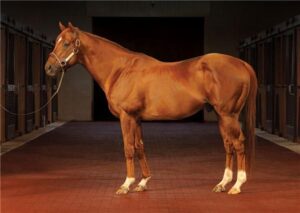 There is nothing to laugh about in the achievements of Distorted Humor. This amazing racehorse had a successful career on the racetrack before being retired to stud and becoming the leading American sire of 2011. His progeny have competed for the Triple Crown and also led their respective circuits in earnings. He later became a major sire; the historical stud fee discussed below is not a current price.
A Late Bloomer
A horse does not have to be a Triple Crown contender to achieve greatness in the sport. Only a small number of horses born each year will go on to compete at age three in the most prestigious series in racing. The rest will manage a varying degree of success. Distorted Humor compiled an impressive record on the track, but the colt did not truly come into his best form until after his three-year-old season.
Distorted Humor was foaled in March of 1993. Under the Northern Hemisphere racing-age convention of January 1, the colt was legitimately close to his actual age when he embarked upon a breakout season at age three. He won the Amsterdam Stakes after a trainer switch saw the colt move to the barn of Elliot Walden. He also captured the Screen King Stakes and posted respectable losing efforts in the Grade II Jerome Handicap and Grade III Fayette Stakes. A third in the King’s Bishop Stakes at Saratoga offered a hint of the things that were to come.
As the colt entered his fourth year, it was apparent that he was a late bloomer. Many popular horses have shown greater talent as they become older and Distorted Humor joined the ranks of these competitors by winning another graded stakes race at four. The Salvator Mile Handicap suited the particular running style of Distorted Humor and the horse won with ease. Throughout the remainder of his career, Distorted Humor competed as a one-mile distance specialist.
At age five the horse capped his respectable career with wins in the Ack Ack Handicap and the Churchill Downs Stakes. These wins brought his career earnings to $769,964. It was decided by the horse’s owner and trainer that the time had come to send Distorted Humor off to stud where he would enjoy his retirement. They had no idea that his earnings as a stallion would far surpass his winnings on the racetrack.
Distorted Humor at Stud
WinStar dates Distorted Humor’s entry to stud to 1999. International breeding activity and the later success of his offspring belong to the stallion chapter, but should not be used to assume that his racing style dictated every descendant’s surface preference. Historical fee figures also need a named season and location; they are not current offers to breed to a pensioned or deceased stallion.
The success was almost immediate. The offspring of Distorted Humor began to amass wins. Of the 93 foals produced by the stallion in his first two crops, 74 of them distinguished themselves as winners on the track. It was then decided that the horse should return to the United States where he would have more opportunities to cover mares with the potential to produce champions.
The American market was not immediately receptive. In 2000, the fee for Distorted Humor was very low and few owners were bringing him their best mares. None of them knew that one of the mares in foal to the stallion was going to produce a horse that would change Distorted Humor’s legacy as a sire.
Distorted Humor’s Influence on American Breeding
Distorted Humor’s emergence as one of the most commercially successful American sires of the early 21st century was built on the foundation of his most famous son, Funny Cide, and confirmed by the breadth and consistency of quality he subsequently produced. His ability to transmit a specific combination of competitive temperament, physical durability, and tactical versatility to his offspring made him a genuinely useful sire across multiple race types and distances, rather than a one-dimensional speed sire or a strictly classic-distance influence.
For modern bettors, Distorted Humor’s bloodline remains relevant because his sons and grandsons continue to compete at major levels, and the physical and mental traits he transmitted persist through subsequent generations. A famous ancestor supplies pedigree context, not a validated guarantee of trainability, consistency or betting returns. Assess the individual runner’s actual form and use defined progeny samples for any proposed bloodline tendency. For more on American sire lines and their influence on modern racing, our articles on thoroughbred sires and pedigree analysis in horse racing cover the key bloodlines. And our guide to Dynaformer racehorse covers another highly influential American sire of the same era.
The Arrival of Funny Cide
Joe and Anne McMahon decided to take a chance on Distorted Humor and allowed him to breed their mare, Belle’s Good Cide. The mare was a granddaughter of the legendary Seattle Slew, so the hopes were high. In 2000, the breeding produced a horse that would be given the name Funny Cide.
Funny Cide’s accomplishments on the racetrack are the stuff of legend. The horse came within one race of capturing the Triple Crown in 2003 and finished his career with earnings of more than $3 million. A champion in his own right, Funny Cide also changed the fortunes of his sire. Suddenly, owners were lining up with their best mares in the hopes that Distorted Humor could also deliver them a champion.
As the new offspring of Distorted Humor began to succeed, the horse’s stud fee rose to astronomical heights. It ranged as high as $300,000 in the aftermath of Funny Cide’s success. Among the other famous racehorses sired by Distorted Humor are Drosselmeyer and Flower Alley. His progeny includes stakes winners and Breeders’ Cup Champions.
Distorted Humor’s stud career has ended; the dated WinStar announcement below records his death in January 2026. His descendants continue his breeding legacy. If you would like to follow and bet on the offspring of Distorted Humor, check out our racebook reviews and choose one for wagering on the races. EZ Horse Betting reviews many racebooks so that you know which ones offer the best bonuses and betting opportunities. Check our Bovada racebook review, Twinspires review or even our Betamerica review. Compare current racebook terms and availability before registering; access depends on your location and the operator’s rules.
Distorted Humor’s completed breeding legacy
This account originally described Distorted Humor as an active stallion. That is no longer current: WinStar Farm says he was pensioned and was euthanized on January 10, 2026, at age 33 because of infirmities of old age. WinStar credits his 23 crops with 167 black-type winners and 72 graded-stakes winners. Those are career totals, not a current stud fee or an offer to breed to him. Read WinStar’s announcement.
Funny Cide is the clearest connection for a racing reader: a son of Distorted Humor who won the 2003 Kentucky Derby and Preakness. The distinction between a horse’s own racing record and the record of his offspring is essential here. Distorted Humor’s influence was substantially greater at stud than on the track, but his progeny’s victories should not be counted as his personal wins.
Distorted Humor: Racing Record and Breeding Legacy
| Measure | What the number represents |
|---|---|
| $769,964 | His own racing earnings |
| 167 black-type winners | Career progeny total reported by WinStar |
| 72 graded-stakes winners | A subset of that progeny record |
| 23 crops | Career breeding sample reported in the announcement |
These are separate measures from WinStar’s January 2026 announcement. Do not add graded winners to black-type winners as if they were separate groups, and do not count offspring earnings as the stallion’s own race winnings.
Related research
Continue the Analysis
Racehorse Profiles
Explore notable horses, breeds, form, and stories from racing history.
ContinueJockey Profiles
Browse riders, careers, records, and the craft of race riding.
ContinueTrainers & Training
Learn conditioning concepts and browse trainer profiles.
Continue