
Jack Van Berg
On this page 8 sections
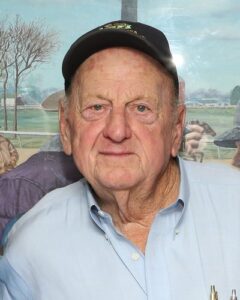 Jack Van Berg has a permanent place among the legends of horseracing. Van Berg trained 6,523 winners during a career that ended with his death in 2017 at age 81. His most noteworthy accomplishments include winning the Kentucky Derby and the Preakness Stakes in 1987 with Alysheba. Van Berg is known for his straightforward method of training and for being one of the more affable personalities in racing.
From Nebraska to the Racing Hall of Fame
The Van Berg family is no stranger to horse racing. Jack is the son of Hall of Fame trainer Marion Van Berg. The young Jack began his career in the family’s Nebraska operations and began training his own stable of horses at small tracks like Ak-Sar-Ben Racetrack in Omaha. It is noteworthy that Van Berg managed to lead the nation in earnings in 1976 while toiling away on a small circuit. He also amassed 496 wins that year, no small feat at any racetrack.
Van Berg soon outgrew the tracks of Nebraska and began to compete on the biggest racetracks in the United States. At Arlington Park in Chicago the trainer accomplished a very significant milestone. The date was July 15, 1987. Van Berg scored win number 5,000 with Art’s Chandelle. By 2008, Van Berg was second on the all-time wins list for American trainers.
His accomplishments landed Van Berg a spot in the National Racing Hall of Fame in 1985. This is very significant when you realize that most inductees receive their honor toward the end of their careers. Van Berg was just getting started. He continued training after induction; his completed career ended with his death in 2017. Induction and retirement therefore belong to different points in the chronology.
Jack Van Berg and Alysheba
Without question, the most important horse in Van Berg’s stable was Alysheba. Van Berg won two legs of the Triple Crown with Alysheba in 1987 and captured the Breeders’ Cup Classic in 1988. Alysheba was also a successful sire in retirement and produced 11 winners of graded stakes races.
As a two-year-old racehorse, the young Alysheba was relatively unimpressive compared to other top stakes horses of the same age. The horse did not blossom until his three-year-old year under the patient handling of Van Berg.
One of the core principles embraced by Van Berg has been to allow a horse to continue to race when they are older. There is a tendency for trainers to retire male champions early so that owners can capitalize on stud fees and to protect the horse from the possibility of injury. Van Berg has been very outspoken in his belief that horses should be kept in competition as long as they feel good and continue to perform well.
Alysheba was an example of Van Berg’s mentality. He raced the horse many times after its Triple Crown series victories. Some would argue that Alysheba even produced his best season in his four-year-old year when he won seven stakes including the Breeders’ Cup Classic.
Influence on other trainers
Like many trainers of the modern era, Jack Van Berg took an active role in mentoring other young horsemen. Bill Mott and Frank Brothers both honed their skills under the watchful eye of Van Berg. Mott would later go on to train the legendary Cigar.
To be an apprentice for Van Berg was certainly not easy. The trainer could be tough but fair. He was able to pass on his knowledge in such a way that it left a lasting impression on all those who learned from him.
Van Berg had an outgoing demeanor to be sure, but those who have served under him know that he demands excellence at every turn. His stable’s reputation for standards is part of the career account, but it is not a guarantee that every outcome was controllable. Horse care, conditioning, entries and race results involve different decisions and uncertainties.
Archived charts and replays allow readers to study Van Berg’s horses after his death. For current racing, use the racebook comparison and operator reviews to research eligibility and terms. Account creation does not guarantee free data, every track or a welcome credit; check the actual conditions before depositing. A historical trainer profile is not an invitation to bet on current starters from a deceased trainer.
Jack Van Berg’s Training Philosophy and Its Legacy
Jack Van Berg’s remarkable career — which produced over 6,500 training wins across multiple decades and included a Kentucky Derby victory with Alysheba in 1987 — was built on a training philosophy that combined high volume with genuine individual attention to each horse in his care. Running a large stable successfully requires systems that ensure no horse is neglected despite the volume, and Van Berg developed operational routines that maintained standards across his enormous operation while still identifying and developing the specific horses whose talent warranted individual attention.
His ability to peak horses for major races while maintaining the day-to-day health and soundness of a large claiming and allowance stable reflected a versatility unusual in trainers, who often excel at one level of the sport or the other but rarely both. The claiming stable experience — where horses arrive and depart frequently and where form must be assessed and acted upon quickly — developed an instinctive form-reading ability that served him equally well when he was preparing a Grade 1 horse for a major stakes race. For bettors who follow trainer patterns, Van Berg’s career illustrates how deep operational competence at all levels of racing translates into consistent results at the top. For more on great American trainers, our profiles of Nick Zito and Tom Smith cover other legendary figures. And our guide to betting trainers in horse racing covers how to use trainer knowledge in your handicapping.
Completed career record
The National Museum of Racing and Hall of Fame records Van Berg’s career from 1957 until his death in 2017. He trained 6,523 winners with $85,925,482 in earnings and became the first trainer to reach 5,000 wins. He entered the Hall of Fame in 1985.
| Measure | Result | Context |
|---|---|---|
| Career wins | 6,523 | Lifetime total. |
| Best annual wins | 496 · 1976 | One calendar year. |
| National wins leadership | 9 seasons | Separate from earnings leadership. |
| Eclipse Award | 1984 | Outstanding Trainer. |
| Hall of Fame | 1985 | Induction before the final decades. |
Alysheba and the record
Van Berg trained Alysheba to the 1987 Kentucky Derby and Preakness and six Grade 1 wins in 1988, including the Breeders’ Cup Classic. Alysheba was Horse of the Year and champion older male in 1988. Van Berg had earlier won the 1984 Preakness with Gate Dancer.
Studying a high-volume stable
- Use win percentage with the win total.
- Separate circuit titles from national leadership.
- Compare stakes and claiming samples.
- Check whether a horse improved by speed figure, class result or both.
- Avoid applying historic patterns to a trainer who is no longer active.
The completed chronology keeps his later career distinct from an earlier active-trainer snapshot. Source note: Career dates, totals, awards and major wins were checked against the National Museum of Racing and Hall of Fame.
Compare a stable’s scale with its strike rate
A high-volume operation can lead by total wins while another has a higher percentage from fewer starters. For example, forty wins from two hundred starts is 20%, while thirty from one hundred is 30%. Neither number alone establishes betting value because the odds and quality of runners differ.
Use the career summary to choose a historical campaign to study, then inspect the individual races. With Alysheba, keep the three-year-old classic campaign separate from the following season. That chronological approach explains development more clearly than assuming the horse performed identically in every start.
Related research
Continue the Analysis
Racehorse Profiles
Explore notable horses, breeds, form, and stories from racing history.
ContinueJockey Profiles
Browse riders, careers, records, and the craft of race riding.
ContinueTrainers & Training
Learn conditioning concepts and browse trainer profiles.
Continue