
Man o’ War: Career Record and Racing Legacy
On this page 4 sections
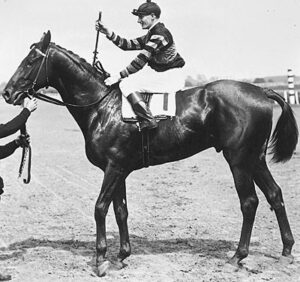 If you ask a non-racing fan to name a racehorse, the chances are pretty good that they will be able to name Man o’ War. The legendary horse’s popularity transcended racing, and he is almost as recognized as a sire as he is for his accomplishments on the racetrack. Winning 20 of his 21 career races, Man o’ War went on to sire Crusader, War Admiral, and Hard Tack. It is rare for a horse to succeed as wonderfully in both aspects of a racing career as Man o’ War did.
His early racing career
Man o’ War was foaled in Kentucky on March 29, 1917. In North American Thoroughbred racing, horses advance an official year in age on January 1, so when Man o’ War began his racing career in June of 1919 he was actually a little over two years old. He won his debut at Belmont Park by six lengths and went on to have a stellar rookie year, capturing multiple stakes races at Aqueduct and Saratoga. During that two-year-old season, Man o’ War won four races in a span of 18 days. That schedule differs from many modern campaigns. It does not by itself prove a universal change in horses’ physical durability; race placement, management and opportunity also affect start frequency. His only career loss came to Upset in the 1919 Sanford Memorial at Saratoga. The race used the starting methods of that era rather than modern stalls. A poor start, traffic and a late challenge all feature in the accounts. The Keeneland Library preserves Johnny Loftus’s contemporary explanation, including his own decisions about the available path. The result should not be reduced to one uncontested claim about the horse’s orientation at the start. In the later match race, Man o’ War was represented by his grandson (through Hard Tack), Seabiscuit and his son, War Admiral. A walk-up start was also used at the request of War Admiral’s trainer.
The unbeaten 1920 season
Trained at age two by Louis Feustel and ridden by jockey Johnny Loftus, Man o’ War embarked upon his three-year-old campaign with a new jockey in the irons. Loftus had been denied a jockey’s license and subsequently became a trainer. The new rider was Clarence Kummer. Kummer and Man o’ War were surely positioned to make a run at the Triple Crown, but the horse’s owner refused to run in Kentucky and bypassed the first jewel of the Crown. He won the Preakness and Belmont in 1920. Later in the season, his dominance helped reduce some races to very small fields.
Man o’ War took the track for the final time in the Kenilworth Park Gold Cup to compete against Sir Barton in a match race. Sir Barton had won the Triple Crown in Man o’ War’s two-year-old year. Man o’ War was so dominant in the race that his jockey slowed him near the end, but the incredible horse still won the race by seven lengths.
View the linked Man o’ War–Sir Barton race footage on YouTube.
By the time his historic career was over, Man o’ War had set three world records, two American records, and seven track records, while equalling another track mark. The colt was a horse for the ages and he was only aged three. The decision was made to send Man o’ War to stud in Kentucky. He would spend the next 22 breeding seasons siring 379 foals. The most successful of these offspring were War Admiral and War Relic. The War Relic line still exists today, and Man o’ War appears no less than 17 times in the bloodline of 2015 Triple Crown Champion American Pharoah
Retirement and memorial
After his death in 1947, Man o’ War was buried at Faraway Farm. His remains and Herbert Haseltine’s statue were moved to the Kentucky Horse Park in 1977. See the National Museum of Racing profile and the Keeneland Library’s statue history. He was also honored with inclusion in the National Racing Hall of Fame. The horse has also been named as the No.1 Thoroughbred Champion of all time by The Bloodhorse. Sports Illustrated has also named Man o’ War as the greatest racehorse of all time. Every year, many fans of horse betting make a visit to Man o’ War’s final resting place in tribute to this great champion.
Compare eligibility, available markets and settlement terms through our racebook comparison and the Bovada, TwinSpires and BetAmerica review pages.
Man o’ War’s Enduring Legacy in Racing Culture
Man o’ War’s status in American racing history transcends the record books and the statistics. He has become a cultural symbol of equine excellence so powerful that his name is invoked whenever a new horse is described as potentially exceptional — the highest compliment available in American racing parlance. This cultural weight reflects not just what he achieved on the racetrack but how he achieved it: with a dominance so complete that his rare defeats were treated as anomalies requiring explanation rather than evidence that he had been beaten on merit.
His single career defeat, to the aptly named Upset in a 1919 race, has become one of racing’s most discussed results precisely because it contradicted the narrative of invincibility that his form otherwise created. The lesson for bettors is instructive: even the greatest horses lose, and a single defeat — however surprising — does not automatically indicate permanent form reversal. When assessing a horse that has produced exceptional performances and then suffered an unexpected defeat, the context matters enormously: was the defeat due to track conditions, pace scenario, or specific racing luck, or did it reflect a genuine form decline? Answering this question correctly separates the bettors who recognise temporary setbacks from genuine declines. For more on Man o’ War’s place in history, our article on the 12 greatest race horses of all time covers his era. And our guide to Secretariat profiles the horse most frequently compared to Man o’ War across the decades.
| Evidence | What can be said | Limit |
|---|---|---|
| 20 wins in 21 starts | An exceptional completed record | Not a probability for a modern race |
| 1919 Sanford defeat | Upset won; trip and rider decisions were debated | One explanation need not account for the whole result |
| Unbeaten 1920 season | A different campaign from his juvenile season | Fields and conditions still matter |
| Stud descendants | Influence through later generations | Pedigree presence alone does not predict performance |
Related research
Continue the Analysis
Racehorse Profiles
Explore notable horses, breeds, form, and stories from racing history.
ContinueJockey Profiles
Browse riders, careers, records, and the craft of race riding.
ContinueTrainers & Training
Learn conditioning concepts and browse trainer profiles.
Continue