
Swaps – Racehorse
On this page 6 sections
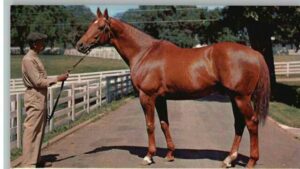 The California Comet is still talked about on the West Coast racing circuit today. The legendary Swaps was a winner of the Kentucky Derby and the son of a European stallion. He was immortalized with his own statue at Hollywood Park, and races have been named in his honor. The accomplishments of the great horse are even more spectacular when one considers the various injuries and ailments the horse was forced to endure while racing.
A Horse Racing Champion is Born
There is a saying about the month of March: in like a lion, out like a lamb. Swaps could very well be a horse racing representation of that statement. The chestnut colt was foaled on March 1, 1952. His owner and breeder Rex C. Ellsworth was no stranger to the racing industry, but he was one of many owners who had struggled to acquire a horse that could change the fortunes of his farm. Such is the case for many owners.
Swaps had a most impressive pedigree. His sire was Khaled, and his dam was Iron Reward. At the time, such breeding was uncommon in the United States. The dam of Swaps also had an impressive bloodline. Her half-brother, Iron Liege, was a winner of the Kentucky Derby. It was decided that Mesh Tenney would handle the training. Ellsworth was an old cowhand who had little tolerance for the blue bloods who dominated horse racing at the time. He chose to work with Tenney in all likelihood because the trainer was not particularly well-known in horse racing circles.
For all his lack of prior success, Tenney had an easier task with the talented Swaps. The colt was impressive from the very beginning. He began his 1955 campaign with a stunning win in the San Vicente Stakes. It was an impressive victory that placed the horse in consideration for a place in the 1955 Kentucky Derby. Bill Shoemaker would ride Swaps in the 1955 Derby. His famous finish-line mistake aboard Gallant Man came in the 1957 Derby, two years later, when Iron Liege won. It therefore cannot explain Shoemaker’s thinking before the 1955 race. The family connection through Swaps’s dam is also different from saying the younger Iron Liege appears as an ancestor in Swaps’s pedigree.
Swaps Vs. Nashua
The primary rival that would face Swaps in the 1955 Kentucky Derby was Nashua, a horse from the East Coast that was ridden by Eddie Arcaro. Prior to the race, Arcaro dismissed Swaps entirely as a threat and instead referenced Summer Tan as the horse to beat. This comment incensed the West Coast camp of Swaps, and it is reflective of a division in horse racing that has persisted to the present day.
East Coast racing circuits have always been the domain of racing’s elite. Some of those elite had a tendency to look down on horses from California. The spectacle of racing in California with its celebrity owners and attendees didn’t set well with eastern owners who still saw racing as an exclusive club that should not be available to the masses. Even today, West Coast racing fans are engaged in a constant struggle to prove their horses are superior.
Swaps and team apparently did not receive the memo issued by Arcaro. Swaps handily defeated Nashua in impressive fashion. Although Nashua would return to capture both the Preakness and the Belmont Stakes, the win in Kentucky was enough to establish Swaps as a champion race horse. After the race the colt was found to be suffering from a hoof ailment that would have sidelined many lesser race horses. He did not make the trip to Baltimore or New York, and instead took time off. When he returned, Swaps reeled off multiple wins and broke track records at numerous distances. All the while, the camp of Nashua watched with growing irritation. Even though their horse had won two legs of the Triple Crown, Swaps was far more popular. The handlers of Nashua began to clamor for a return contest between the two horses, and, after much negotiation, a race was arranged.
The race would be contested at Washington Park in Chicago on August 31, 1955. The weather had been poor, and in a workout the day before the race the California Comet injured his hoof once again. Not wanting to make excuses, the Swaps camp chose to proceed with the race. Arcaro forced Shoemaker to race on the worst part of the track’s surface in the early stages of the event. Nashua would go on to win by several lengths. The eastern fans celebrated as Nashua went on to be named the 1955 Horse of the Year while Swaps was once again forced to heal.
Swaps at Age Four
Swaps would return to racing at age four, despite lingering issues with his hoof. He raced well enough to be named the United States Horse of the Year in 1956, but some of the eastern race fans had taken to calling him the California Cripple. In October of 1956, Swaps would fracture a leg in two places. A fracture is a serious veterinary problem, but prognosis depends on the injury and available care; being a famous horse does not make recovery predictable.
The horse was placed into a cast, but just a week later he began to thrash in his stall and extended the two fractures. As a gesture of goodwill, Sunny Jim Fitzsimmons, the trainer of Nashua, sent a special sling to Belmont Park where the horse was stabled. Mesh Tenney used the sling, and some days he would spend hours holding up the leg of Swaps to prevent any further damage. The effort worked, and in November of 1956 Swaps was pronounced well enough to be retired to stud.
Swaps and the California Racing Tradition
Swaps’s career is deeply intertwined with the development of California as a major racing state in the 1950s, a period when the Golden State was establishing itself as a genuine powerhouse of American thoroughbred racing. His victories at Santa Anita and Hollywood Park during this era helped raise the profile of California racing to the point where it could compete with the established Eastern circuits for the sport’s most talented horses and trainers. The competition and rivalry that Swaps generated — most memorably through his matches with Nashua — captured national attention in ways that elevated racing’s cultural profile across the country.
California’s racing scene has evolved dramatically since Swaps’s era, facing significant challenges in the 21st century that his connections could not have imagined. The deaths at Santa Anita, the ongoing debate about the sport’s future in the state, and the changing regulatory environment have created uncertainty about California racing’s long-term trajectory. Against this backdrop, horses like Swaps serve as reminders of what California racing has been at its best — and as inspiration for those working to ensure it can achieve that standard again. For more on great American racehorses, our articles on the 12 greatest race horses of all time and Seattle Slew racehorse cover other legends of American racing. And our article on California Governor wants to ban horse racing provides context on the modern challenges facing the state’s racing industry.
Swaps in Retirement
Swaps performed reasonably well as a stud, siring 35 stakes winners. His breeding record should be judged through verified offspring rather than an assumed reaction from an entire regional racing community. Still, the horse remains a California hero that was immortalized with a statue at Hollywood Park and had a stakes race named for him at that same track.
Swaps earned almost $850,000 in his career and amassed a record of 19-2-2 from 25 starts. He was inducted into the United States Racing Hall of Fame in 1966.
Would you like to bet on horses from California like Swaps? You can when you create an account with one of our recommended online horse betting sites. Signing up is easy and you can be making bets from your computer, phone, or tablet. Sign up today and qualify for a nice welcome bonus. Check our Bovada racebook review, Twinspires review or even our Betamerica review. All great choice if you are in the US. online racebook comparison for folks anywhere!
The rivalry and the wider career
| Period | Result | Context |
|---|---|---|
| 1955 Kentucky Derby | Swaps defeated Nashua | The West Coast colt won the Classic. |
| 1955 match race | Nashua defeated Swaps | A separate race with a different result. |
| 1956 campaign | Eight wins in ten starts | Swaps earned Horse of the Year recognition. |
| Retirement | Thirty-five stakes-winning offspring | Breeding achievements belong in a separate record. |
Historic speed records need their distance, surface, venue and date attached. A track record concerns one course, while a wider record has a different comparison group. Neither guarantees an advantage across unrelated racing conditions. Swaps’s 25-start career and 1956 campaign provide a stronger basis for assessing him than turning either meeting with Nashua into a universal verdict.
Related research
Continue the Analysis
Racehorse Profiles
Explore notable horses, breeds, form, and stories from racing history.
ContinueJockey Profiles
Browse riders, careers, records, and the craft of race riding.
ContinueTrainers & Training
Learn conditioning concepts and browse trainer profiles.
Continue