
Laffit Pincay, Jr.
On this page 7 sections
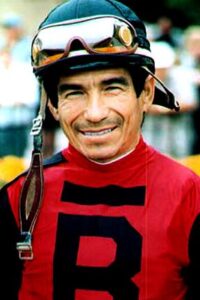 There are jockeys, and then there are racing legends. Laffit Pincay, Jr. definitely belongs in the legend category. It is easy to make a case that Pincay is the greatest jockey to ever ride a horse, and his long career gave horse-racing followers many memorable rides to study and appreciate.
Panama and the American debut
Laffit Alejandro Pincay, Jr. was born on December 29, 1946 in Panama City, Panama. His father was a successful jockey on the tracks of Panama and Venezuela, so Laffit was exposed to the business of horseracing from a very young age. After obtaining his jockey license and having success in his native country, Pincay garnered the attention of American horsemen. Owner and breeder Fred W. Hooper and jockey agent Camilo Marin believed that Pincay would do well in the United States and convinced him to move his tack north. His American debut took place at Arlington Park in Chicago, and Pincay was an immediate success. He won eight of his first eleven races and sent a message that he had the skills to compete with the best riders.
As it so often happens in horseracing, Pincay reaped the benefits of his early success by getting placed on better horses. Many jockeys have had their careers boosted or stalled by their initial performances. His early results drew attention, and he has explained that after his successful debut at Arlington most of the mounts he received were of high quality. Pincay made the most of his good fortune and rode hard, but he also had an affable personality that resonated well with horsemen and racing fans. His sportsmanship later earned the George Woolf Memorial Jockey Award in 1970 and the Mike Venezia Memorial Award in 1996. Those honors recognized his conduct over a much longer period than his initial American success. The awards document recognition for sportsmanship and conduct. They do not establish an absolute claim that every race or interaction was free of controversy. Describing the particular honors is more useful than making a universal statement about a long career.
Sham and the 1973 Triple Crown
In 1973, Pincay would be thrust into an emotional roller coaster that became an example of how cruel the racing gods can be. Pincay was chosen by trainer Frank “Pancho” Martin to ride the stellar colt Sham. Sham became a major three-year-old contender and a central rival in the 1973 series. Yet, there was another horse on the East Coast that was making a name of his own—Secretariat. It seemed written that the two would have a great rivalry, and they did, and Sham became one of Secretariat’s best-known rivals. Claims about what Sham certainly would have achieved in another year are opinion, not a historical result. Secretariat and Sham faced off for the first time in the Wood Memorial where Sham bested an ailing Secretariat and finished second. Secretariat, battling an infection in his mouth which made the bit uncomfortable, was third. The stage was then set for the Triple Crown series.
Secretariat recovered in time for the Kentucky Derby and set a track record, with Sham finishing second. Some accounts assign Sham an individual time below two minutes, but the official result records finishing margins rather than an independently timed performance for every runner. A time calculated from a finishing margin is an estimate, not a separate official timing of Sham.
The story was much the same in the Preakness Stakes two weeks later. Sham once again ran a phenomenal time but could not best Secretariat. As the horses made their way to the Belmont Stakes, Sham was now relegated to the role of spoiler. Trainer Pancho Martin decided to try a new approach. The Belmont developed into an early duel between Sham and Secretariat. The observed pace can be studied from the race; it should be distinguished from unverified private instructions. The failure was catastrophic. Secretariat responded to the early challenge by running faster as the race progressed, leaving the exhausted Sham and the rest of the field in his wake on the way to a 31 length victory.
For his part, Pincay took the fortunes of horseracing in stride. He did not publicly treat the losses as a grievance. Whether Sham would have won the Triple Crown without Secretariat cannot be known. Pincay continued his winning ways, moving to California and winning the Hollywood Gold Cup a record nine times. In 2004, Pincay was honored with the creation of the Laffit Pincay, Jr. Award. The award began at Hollywood Park and recognizes service to racing across occupations, not only jockeys. A life-sized bust of Pincay was also placed at Santa Anita park.
Pincay’s own Classic and career achievements
Pincay won the 1984 Kentucky Derby aboard Swale and three consecutive Belmont Stakes: Conquistador Cielo in 1982, Caveat in 1983 and Swale in 1984. He also won seven Breeders’ Cup races. The National Museum of Racing profile records these results.
The wins record changes hands
All of Pincay’s accomplishments are too great to list, but he amassed 9,530 wins in his stellar career. Many of them were stakes races and high-profile events. Pincay held the career wins record until December 1, 2006, when Russell Baze recorded win 9,531. Before that date, Baze was approaching the total, but the eventual record-breaking ride was still in the future. A milestone is an achieved result rather than a certainty before the race. Pincay made his way to California where he attended the races on consecutive days so that he could be there when Baze broke the record. When it finally happened, Pincay joined Baze in the Winner’s Circle to shake his hand and congratulate him. Many had posed the theory that Baze’s record should be annotated because most of his wins came on less competitive circuits while Pincay earned his in the toughest races in America. Ever the man of class, Pincay dismissed these claims and praised Baze for his efforts while asserting that winning any horse race is a difficult feat.
Compare eligibility, race coverage, settlement terms and current offers through our racebook comparison and the Bovada, TwinSpires and BetAmerica review pages.
Riding reputation and handicapping context
Pincay was celebrated for strength, balance and longevity. Those descriptions help explain his reputation, but they do not measure a fixed advantage that can be added to every mount. Bettors should evaluate the horse, trip, competition, current rider form and price together.
His 9,530 wins and long tenure at major California tracks are documented achievements. For related profiles, see Angel Cordero and Bill Shoemaker. The jockey-handicapping guide explains how to use recent evidence without treating reputation as a guarantee.
The People Behind the Pincay Award
The range of recipients helps explain the award’s purpose. Del Mar’s 2026 announcement named racing executive Joe Harper the 22nd recipient and listed earlier winners. They include trainer Richard Mandella, announcer Trevor Denman, veterinarian Gregory Ferraro and owner Mike Pegram, alongside riders such as Julie Krone and Mike Smith.
A jockey’s wins are a count of race results; this award recognizes a broader contribution to the sport. Someone can earn it without a professional riding record. That distinction also explains why the award should not be confused with a seasonal jockey championship or a race named in Pincay’s honor.
Pincay’s own story spans both kinds of achievement. The 9,530 victories quantify his riding career. His welcome for Baze when the record changed hands illustrates the sportsmanship emphasized elsewhere in this profile. Neither record comparisons nor opinions about circuit strength need to erase the individual accomplishments of either rider.
A completed career in perspective
The Museum of Racing record lists a 1966–2003 career and Hall of Fame induction in 1975. Induction took place long before the final win total, so the recognition and the completed record belong to different dates.
| Measure | Achievement | Interpretation |
|---|---|---|
| Career wins | 9,530 | Cumulative results across many seasons. |
| Derby win | Swale · 1984 | One classic-winning partnership. |
| Belmont wins | 1982, 1983 and 1984 | Three consecutive editions with three different horses. |
| Breeders’ Cup wins | 7 | Championship victories across divisions. |
| Eclipse Awards | 5 | Seasonal recognition, distinct from induction. |
Win totals make longevity visible, but they do not fully describe opportunity or competition. Comparisons across eras should acknowledge the number of mounts, the racing schedule and the quality of horses available. Studying the individual races adds detail that a ranking based on one number cannot provide.
Related research
Continue the Analysis
Horse Betting for Beginners
Start with the race, the ticket, pools, odds, and a sensible first-bet workflow.
ContinueUnderstand Bet Types
Compare straight, exotic, and multi-race wagers before building a ticket.
ContinueLearn to Handicap
Build a repeatable process around form, pace, class, distance, surface, and price.
Continue