
What Is A Griffin Race In Hong Kong Horse Racing?
On this page 6 sections
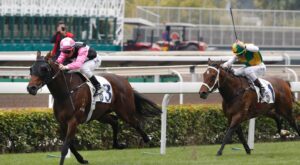 All over the world the sport of horse racing has many colorful terms that are unique to a specific location. This language of the race track is also present in Hong Kong. Those who are new to racing in this part of the world might want to know, what is a griffin race in Hong Kong? EZ Horse Betting has the answer.
The Griffin in Hong Kong
Horse racing in Hong Kong is a sport which is typically well-organized. When you consider the number of horses that compete at tracks all over the world, a hierarchy of races is a must. Those who bet horses regularly refer to this hierarchy as class or a class ladder. A higher rating generally places a horse in a stronger class, but class assignment is not a guarantee of its performance in the next race.
A ladder must have a bottom rung, a place where all horses begin their journey toward horse racing greatness. In America and other locations this class of horses are called maidens. A maiden is a horse that has never won a race. In Hong Kong, an unraced imported horse may be classed as a griffin; not every maiden is a griffin. The term reflects a bit more than just a horse that has yet to win a race, though.
In Hong Kong the griffin is a horse that has been imported to the region unraced. This means that it has not competed in a race before it arrives in Hong Kong. Many horses are bred and trained to race in Hong Kong because the purse structures are generous. A horse that has talent can make much more money racing in Hong Kong than it can racing in other parts of the world.
Griffin races pose a challenge for the Hong Kong handicapper. It can be very difficult to assess the abilities of a horse that has never seen competition. There are a few things you can look at which may help you pick the winner of a griffin race.
The Long Road of a Griffin
Many people have the assumption that it is an easy task to get a horse to the race track in good condition. This is simply not the case. The path any young horse takes to become a competitor is fraught with obstacles and peril. Not every Thoroughbred foal becomes a race starter; the proportion depends on the country, crop and records used. Of those who do, a large number of them will end their career as a maiden without a single win to their credit.
The griffin’s journey to the Hong Kong race track begins not long after the horse is foaled. Within the short span of six months or so its owners and possibly trainers will begin to evaluate the horse’s talent. Some horses will never move beyond this stage toward racing. Females will be saved as a broodmare to breed more horses if their bloodline shows promise, or males may be gelded and sold off to other horse lovers. These sold horses might wind up in equestrian competitions, or some of them could just end up in a pasture.
The griffins that do pass muster will be entered into a training program by the time they reach one year of age. At this point a horse is called a yearling, and its eventual racing career still depends on development, health and later decisions. The yearling will have to become accustomed to human contact and handling. It will have to learn how to do basic things like allow itself to be groomed. The yearling stage is very delicate because the frame of the horse is still developing. Too much stress on those young joints could cause the horse injury.
Once the horse reaches two years of age the real work begins. This is when the potential griffin will learn to train as a racehorse. It will be taught to accept a saddle, gallop around the track, and even have its first timed workout. During this all-important two-year-old season the horse may also make its trip to Hong Kong for a griffin race.
Handicapping Hong Kong Griffin Races
Hong Kong racing attracts substantial betting activity, but a large pool does not guarantee a profitable wager. A lot of betting action takes place and this creates large wagering pools for bettors. This is especially true with griffin races where the odds on each horse can be very high.
A griffin race is difficult to handicap because bettors don’t have a lot of information to work with. A debutant has no race results, but a horse imported unraced may subsequently have Hong Kong starts. Check each runner’s actual record rather than assuming a griffin label means it has never raced. The best place to start looking when evaluating a griffin is the workout tab. This tab is usually located at the bottom of the past performances. It will list all the official workouts that the horse has had, the distance of the work, and the time in which it was completed.
Many bettors get too focused on times when looking at workouts. A workout time is one piece of evidence, not a complete account of fitness or intent. Distance, surface, company, timing method and how strongly the horse was asked all affect interpretation. Watch available official trial footage and compare the pattern of work with race declarations. Without documented evidence, do not assume a clocker fabricated a time or that a trainer requested a false record. A cautious assessment can recognize the limitations of workout data without making unsupported allegations.
Instead, focus on consistent patterns. If the horse has been working out once a week for the past two months and then goes for three weeks without a workout, what does that mean? There may be several explanations, including a change in programme or reporting. A missing workout alone does not establish lameness; use official veterinary notices and confirmed information rather than diagnosing from a gap. You will have to use your judgment to determine what disruptions to the griffin workout pattern means, but do not underestimate the importance of those patterns.
You can also attempt to evaluate the talent of a griffin in Hong Kong horse racing by looking at its pedigree. The pedigree helps identify the sire, dam and family record, but it cannot tell you everything about this individual horse’s ability. It will even go back farther in the pedigree for a few generations. If the horse had ancestors that performed well then there is a chance this talent was passed on to the horse.
Pedigree analysis is not foolproof. There is no guarantee that a horse will do well because its parents were stakes winners. But this happens often enough to merit consideration as a handicapping factor. It is very useful when handicapping griffins because of the large number of races that are ran on the grass in Hong Kong. Turf success in the family can be relevant to aptitude, but cannot establish that a particular runner is always more likely to win than every rival.
Betting Griffin Races: Value Opportunities in Unexposed Form
Griffin races present one of the most interesting and potentially rewarding betting challenges in Hong Kong racing precisely because of the information asymmetry they create. When horses with no Hong Kong race record compete against each other, the betting market has very little objective form to work with — creating a vacuum that is filled by public impressions of trainer reputation, reported gallop times, and the often unreliable assessments of racing journalists who have watched pre-race work. This information-poor environment calls for wider uncertainty in any probability estimate. Public preparation evidence can help, but it does not establish that a bettor has an edge.
For an unraced import, research from its source country should concern pedigree, preparation and any available trial or work evidence, rather than an overseas race record that does not exist. Once the horse has run in Hong Kong, its local results become relevant. Privately Purchased horses with overseas race form are a different import category. Compare observations under similar conditions and allow for adaptation, transport and preparation; more information can improve understanding without guaranteeing a betting edge. For more on Hong Kong’s unique racing structure, our articles on Hong Kong racing structure and the six classes of Hong Kong horse races provide the essential context. And our guide to no race horse breeding in Hong Kong explains why all horses are imports.
Where Can You Bet a Griffin Race in Hong Kong?
You might be one of the lucky ones that is able to visit the Happy Valley or Sha Tin racecourses in Hong Kong. If you are then you can make a bet on the griffin races at the live betting windows. If you are like most bettors then you will have to find another way to place your wagers. EZ Horse Betting recommends that you find an authorized betting channel that accepts Hong Kong betting action.
Hong Kong residents should use lawful authorized channels. A website listing Happy Valley or Sha Tin does not establish permission to use it from every location. Readers outside Hong Kong need to verify their jurisdiction’s rules and the operator’s race coverage separately. Our racebook comparison can help check features and terms without implying universal eligibility.
What you will not find is betting in Hong Kong provided by bookmakers. The HKJC warns that betting with illegal or overseas bookmakers is against the law in Hong Kong.
Related Articles:
- Happy Valley Racecourse Hong Kong
- Emma Jayne-wilson : Hong Kong Jockey
- Horse Race Betting In Hong Kong
- The Hong Kong Jockey Club
- $1 Billion Dollar Man Of Hong Kong Horse Racing
- Sha Tin Racecourse Hong Kong
- Get Rebates On Hong Kong Racing Bets
- What Is A Griffin Race In Hong Kong Horse Racing?
- Hong Kong Horse Racing Bets
Griffin, maiden and raced import: different labels
| Label | Meaning or evidence to check |
|---|---|
| Griffin | Arrived in Hong Kong unraced; it may later acquire local race form. |
| Maiden | Has not won a race; it may already have raced several times. |
| Privately Purchased raced import | May bring overseas race results that an unraced import does not have. |
| Champion Griffin award | A seasonal award with its own eligibility criteria, separate from a race’s entry conditions. |
The HKJC’s September 2025 announcement changed the Champion Griffin award criteria for 2025/26. Check the relevant season’s rules. For an individual race, use the published conditions and declared runners, then distinguish official trial evidence from assumptions about fitness or health.
Related research
Continue the Analysis
Horse Betting for Beginners
Start with the race, the ticket, pools, odds, and a sensible first-bet workflow.
ContinueUnderstand Bet Types
Compare straight, exotic, and multi-race wagers before building a ticket.
ContinueLearn to Handicap
Build a repeatable process around form, pace, class, distance, surface, and price.
Continue